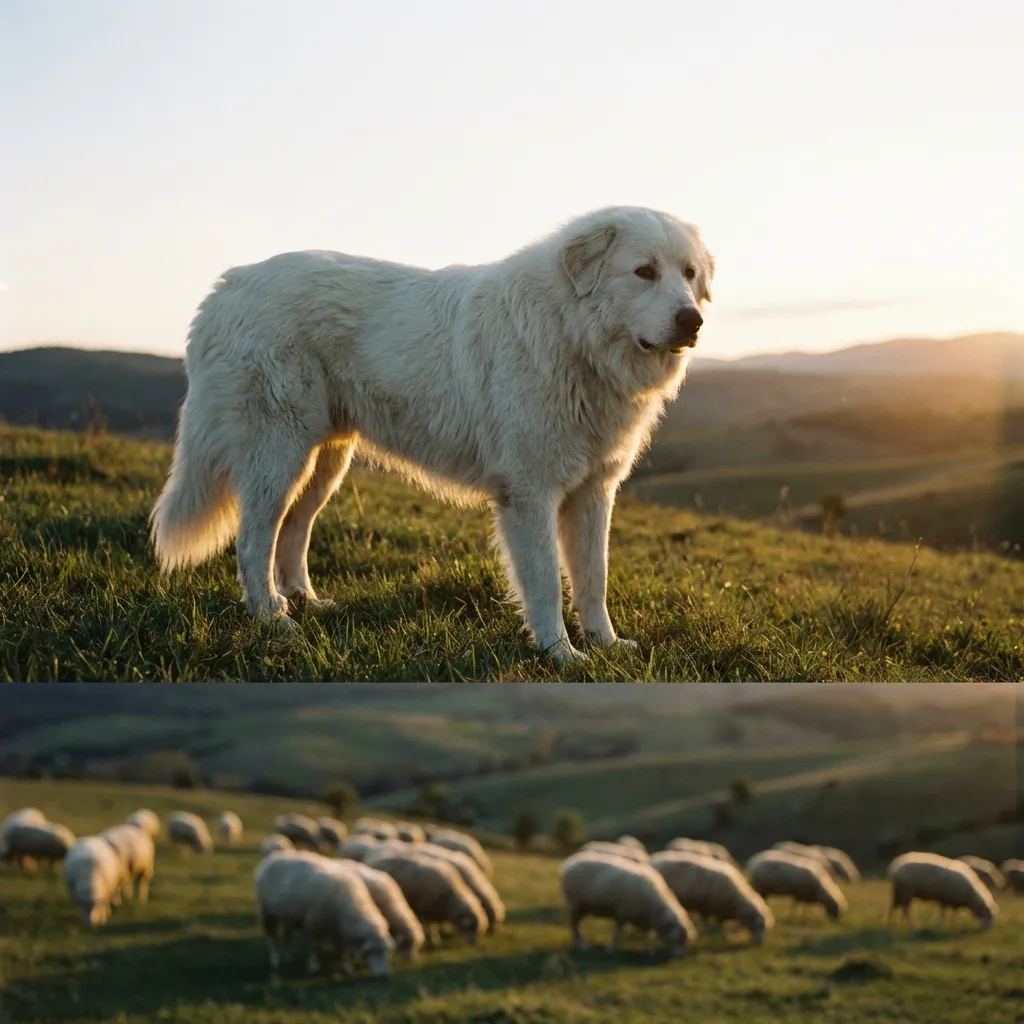
The LGD Escalation of Force
Regardless of the predator, most LGDs follow a similar "Escalation of Force" protocol. They do not want to fight; they want the threat to leave. Fighting risks injury and takes them away from the stock.
Alert Barking
The dog detects a threat (scent/sound) and lets out a deep warning bark. "I know you are there. Stay away."
Posturing & Marking
If the threat persists, the LGD will move between the threat and the stock, marking territory and making themselves look large.
Confrontation
Charging and snapping. This is the final warning. "Leave now or be engaged."
Combat
Physical engagement. This is a last resort.
Predator Threat Assessment Matrix
Different predators require different LGD strategies. This table provides a quick reference for common farm threats:
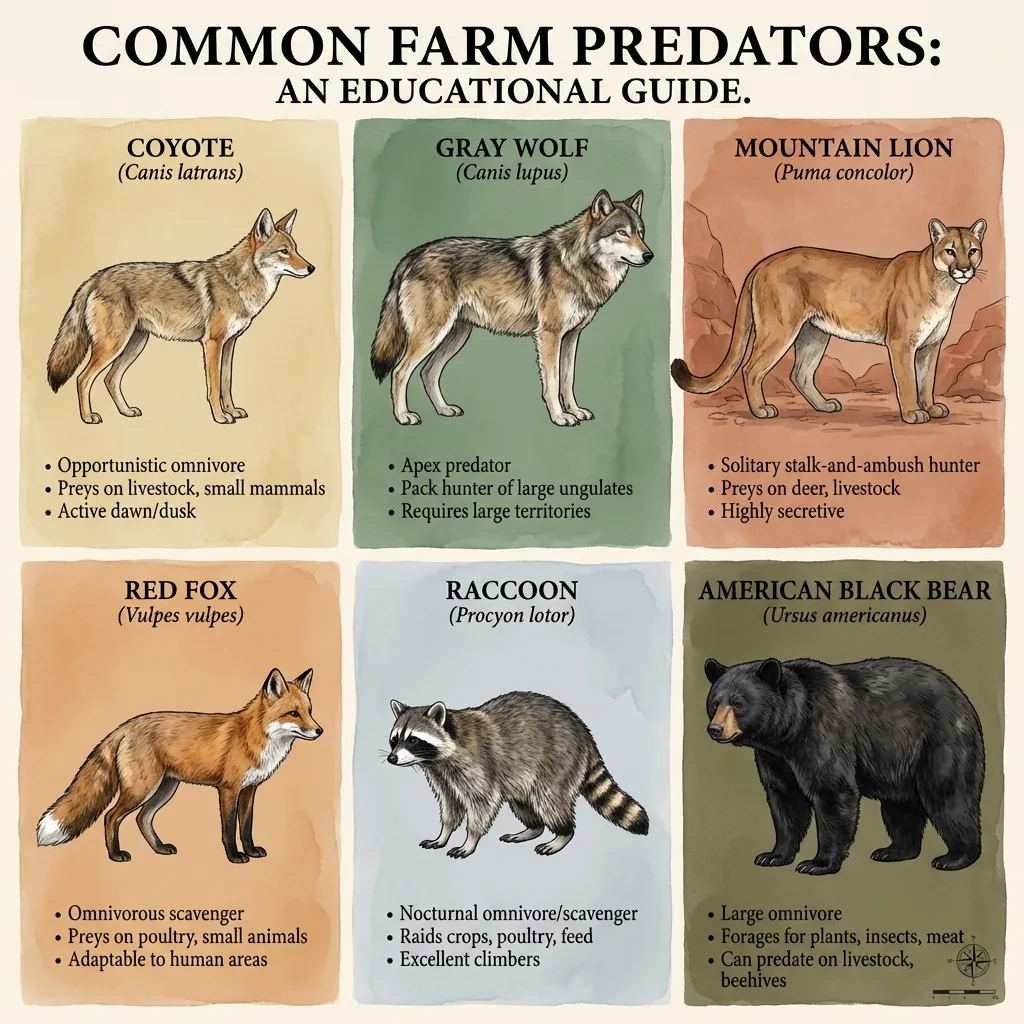
Visual guide to identifying common farm predators
| Predator | Primary Targets | Attack Style | LGD Strategy |
|---|---|---|---|
| Coyotes | Sheep, goats, poultry, calves | Throat bite, pack hunting | 1-2 dogs, disruption effective |
| Golden Jackal (Learn more) | Lambs, poultry, newborns | Opportunistic, mated pairs | LGDs temporally displace them |
| Eurasian Lynx (Learn more) | Sheep, goats, roe deer | Silent ambush, throat bite | LGD presence & marking effective |
| Spotted Hyena | Cattle, sheep, goats | Bone-crushing bite, pack isolation | Heavy mastiff breeds, spiked collars |
| African Lion | Cattle, livestock herds | Pack ambush, immense absolute force | LGDs provide early warning and buffer |
| Bengal Tiger | Cattle, goats | Solitary ambush, throat/neck bite | LGD alert barking disrupts stealth |
| Wolves | Cattle, sheep, larger ungulates | Pack flanking, leg damage | 3+ dogs required, spiked collars |
| Mountain Lions | Sheep, goats, cattle, horses | Ambush, neck/skull bite | Barking removes surprise, clear brush |
| Bears | Sheep, cattle, beehives | Slap/bite, milk extraction | Harassment tactics, heel-nipping |
| Feral Dogs | All livestock, esp. sheep | Mutilation, hindquarter focus | Maximum aggression from LGDs |
| Eagles/Vultures | Newborn lambs, kids | Aerial, skull/eye targeting | Limited efficacy, use netting |
| Foxes | Poultry, eggs, young lambs | Nocturnal raiding, take 1 bird | LGD presence, secure coops at night |
| Raccoons | Poultry, eggs, feed | Dexterous, coop breaching | Hardware cloth, LGD patrols |
| Opossums | Eggs, young chicks, feed | Opportunistic, plays dead | Secure coops, LGD presence |
Threat Assessment Tool
Answer a few questions about your farm to get personalized LGD recommendations based on your specific predator threats.
Predators Targeting Farm Animals
We've compiled comprehensive, research-backed guides for the most common predators facing North American farm operations. Select a predator below for detailed behavioral analysis, attack patterns, and specific LGD defense strategies.
Coyotes
America's #1 livestock predator. Learn how LGDs reduce pack and solo coyote predation by 60-80%.
View GuideWolves
The ultimate apex threat. Multi-dog team strategies, pack dynamics, and fladry deterrents.
View GuideBears
Black bears and grizzlies. Seasonal patterns, beehive defense, and LGD harassment tactics.
View GuideMountain Lions
Defeating the ambush predator by neutralizing surprise through early warning.
View GuideFeral Dogs
The underestimated threat. Surplus killing behavior and maximum LGD aggression.
View GuideBirds of Prey
Eagles, hawks, and owls. Where LGDs face limits and how to manage aerial attacks.
View GuideBlack Vultures
The emerging threat targeting birthing livestock. Effigies and mitigation strategies.
View GuideFeral Swine
Wild hogs destroying crops and killing young stock. Realistic LGD expectations.
View GuideFoxes & Small Predators
Foxes, bobcats, raccoons, and weasels. Guarding poultry and implementing coop security.
View GuideCrop Defense
Using LGD territorial presence to deter deer, raccoons, hogs, and pest birds from crops.
View GuideReferences
Musiani, Marco, Charles Mamo, Luigi Boitani, et al. ?Wolf Depredation Trends and the Use of Fladry Barriers to Protect Livestock in Western North America.? Conservation Biology 17, no. 6 (2003): 1538?47. https://doi.org/10.1111/j.1523-1739.2003.00063.x.
Degrazio, Johnw. WORLD BIRD DAMAGE PROBLEMS. n.d.
Young, J. K., J. Steuber, A. Few, A. Baca, and Z. Strong. ?When Strange Bedfellows Go All in: A Template for Implementing Non-lethal Strategies Aimed at Reducing Carnivore Predation of Livestock.? Animal Conservation 22, no. 3 (2019): 207?9. https://doi.org/10.1111/acv.12453.
Timm, Robert M., and Guy E. Connolly. ?Sheep-Killing Coyotes a Continuing Dilemma for Ranchers.? California Agriculture 55, no. 6 (2001): 26?32. https://doi.org/10.3733/ca.v055n06p26.
Connolly, Guy. Sheep and Goat Losses to Predators in the United States. n.d.
Hygnstrom, Scott E. Scott R. Craven University of Wisconsin-Madison. n.d.
Beasley, James C, and W Lafayette. Relationship between Raccoon Abundance and Crop Damage. n.d.
Groepper, Scott R., Scott E. Hygnstrom, Brandon Houck, and Stephen M. Vantassel. ?Real and Perceived Damage by Wild Turkeys: A Literature Review.? Journal of Integrated Pest Management 4, no. 1 (2013): 1?5. https://doi.org/10.1603/IPM12013.
Pearson, Erwin W., and Milton Caroline. ?Predator Control in Relation to Livestock Losses in Central Texas.? Journal of Range Management 34, no. 6 (1981): 435. https://doi.org/10.2307/3898093.
Leopold, A S, S A Cain, C M Cottam, I N Gabrielson, and T L Kimball. PREDATOR AND RODENT CONTROL IN THE UNITED STATES. n.d.
Stull, Daniel W, and Michael T Mengak. Managing Wildlife Damage: Coyote (Canis Latrans). n.d.
Pacific Geographical Institute, Russian Academy of Sciences, S.M. Govorushko, and Far Eastern Federal University. ?MAMMALS AND BIRDS AS AGRICULTURAL PESTS: A GLOBAL SITUATION.? Sel?skokhozyaistvennaya Biologiya, no. 6 (December 2014): 15?25. https://doi.org/10.15389/agrobiology.2014.6.15eng.
Andelt, William F., and Stuart N. Hopper. ?Livestock Guard Dogs Reduce Predation on Domestic Sheep in Colorado.? Journal of Range Management 53, no. 3 (2000): 259. https://doi.org/10.2307/4003429.
Avery, Michael L, and J L Cummings. Livestock Depredations by Black Vultures and Golden Eagles. n.d.
Gese, Eric M, Sean P Keenan, and Ann M Kitchen. LINES OF DEFENSE: Coping with Predators in the Rocky Mountain Region. n.d.
Dolbeer, Richard A, and Nicholas R Holler. IDENTIFICATION AND CONTROL OF WILDLIFE DAMAGE. n.d.
Dolbeer, Richard A, Nicholas R Holler, and Donald W Hawthorne. Identification and Assessment of Wildlife Damage: An Overview. n.d.
Gese, Eric M. Management of Carnivore Predation as a Means to Reduce Livestock Losses: The Study of Coyotes (Canis Latrans) in North America. n.d.
Seward, Nathan W, Kurt C VerCauteren, Gary W Witmer, and Richard M Engeman. Feral Swine Impacts on Agriculture and the Environment. n.d.
Campbell, Tyler A., and David B. Long. ?Feral Swine Damage and Damage Management in Forested Ecosystems.? Forest Ecology and Management 257, no. 12 (2009): 2319?26. https://doi.org/10.1016/j.foreco.2009.03.036.
Hutton, Thomas, Thomas J DeLiberto, Sheldon Owen, and Bruce Morrison. Disease Risks Associated with Increasing Feral Swine Numbers and Distribution in the United States. n.d.
Swanson, David A., Gerald E. Meyer, and Robert J. Stoll. ?CROP DAMAGE BY WILD TURKEY IN OHIO.? Wildlife Society Bulletin 2000, no. S1 (2000): 139?43. https://doi.org/10.1002/j.2328-5540.2000.tb00263.x.
Pugh, Brian. Chapter 13 Predator Control. n.d.