Mountain Lion (Puma) — Species Intelligence
Puma concolorSolitary ambush stalker — Mountain lions rely entirely on stealth. They stalk prey from cover, closing to within 30 feet before a single explosive burst. If the ambush fails, they retreat — they do not chase.
Strictly solitary — Mountain lions hunt, travel, and live alone (except mothers with kittens). They avoid confrontation with groups — making multi-dog LGD teams extremely effective.
Almost exclusively nocturnal — Mountain lions are the most night-specialized livestock predator in North America. Peak activity occurs in deep darkness, not dawn/dusk. This is when LGD nocturnal patrol is most critical.
~400 PSI
Skull: 18–21 cm | vs. LGD: ~743 PSI
Rabies (rare but documented), Feline Leukemia (FeLV — cross-species concern), Plague (Yersinia pestis — flea-borne, documented in western lion populations)
LGDs out-bite mountain lions. At ~743 PSI vs. ~400 PSI, an LGD has a biomechanical edge. The cat's advantage is stealth — which the dog's nocturnal patrol eliminates.
Males: 115–220 lbs (52–100 kg) — Females: 64–141 lbs. Most mountain lions weigh less than a large LGD. The size disadvantage, combined with lower bite force, makes this the predator LGDs are most mechanically equipped to face.
1–6 kittens every 2 years — No fixed breeding season (can breed year-round). Kittens stay with the mother 12–18 months. Moderate reproduction rate — population growth is slower than wolves but faster than bears.
Stable with eastward dispersal. Confirmed sightings and kills increasingly reported east of their traditional western range. Young males disperse long distances — documented crossings into the Midwest. As deer populations increase, suitable habitat grows.
Males: 50–150 sq mi — Females: 20–60 sq mi. Territories are exclusive and vigorously defended. Smaller than wolf or bear ranges, meaning a single lion may repeatedly target the same farm if prey is available.
Clinical Triage & Wound ID
If your dog was attacked by a mountain lion, the wound pattern requires specific triage. For a complete clinical breakdown of wound distribution and severity, see our Forensic Wound Identification Matrix.
Key Takeaways
- LGDs counter ambush by eliminating stealth: A mountain lion's entire hunting strategy depends on surprise. An LGD patrolling at night destroys that advantage — once detected, the lion almost always retreats.
- This is where LGDs have a bite advantage: Unlike wolves (1,141 N canine, BFQ 100.60) and bears (~1,160 PSI / 1,627 N), a mountain lion's ~400 PSI bite force is significantly below an LGD's ~743 PSI. In close quarters, the dog has the mechanical advantage.
- Night patrol is the primary defense: Mountain lions are the most nocturnal of all common livestock predators. LGDs that remain active and patrolling after dark are the most effective countermeasure.
Ambush Tactics
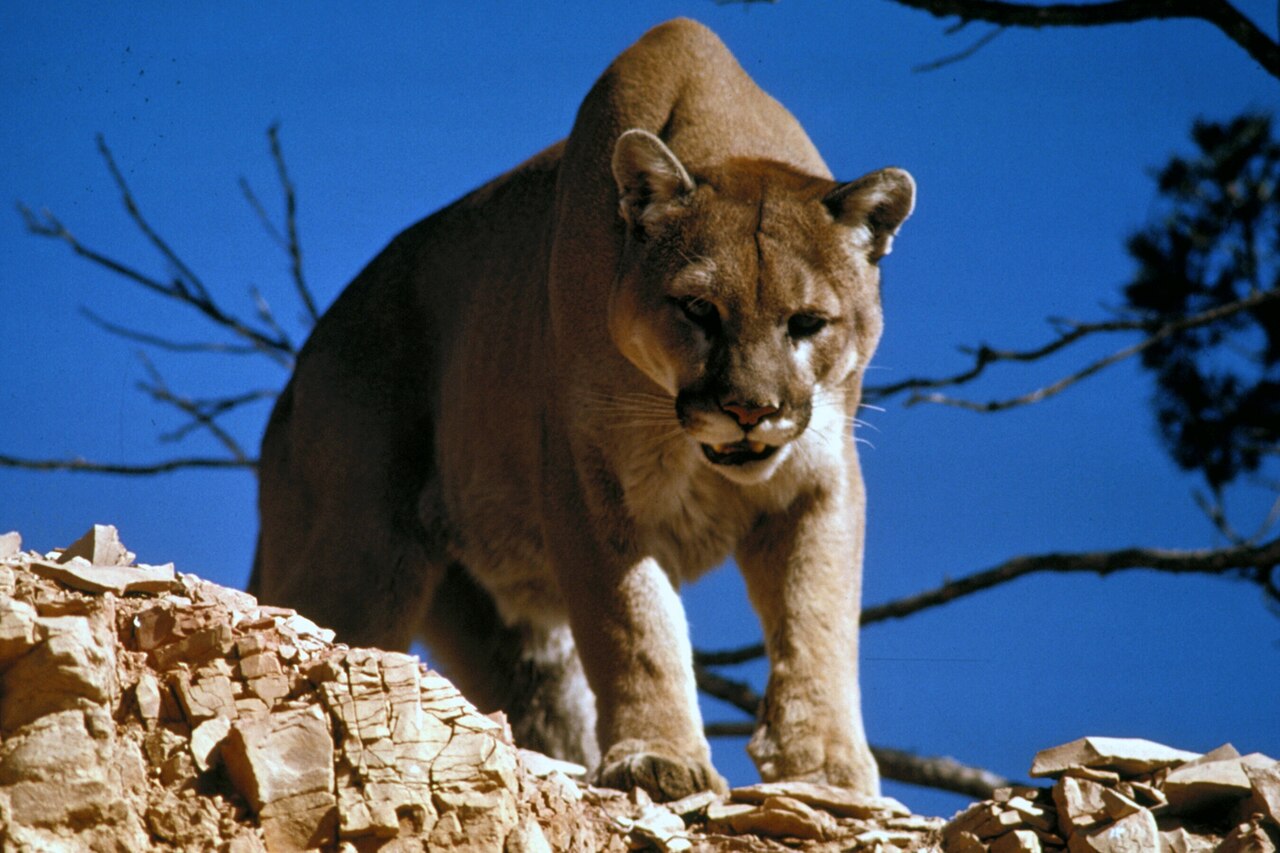
Cougars rely on stealth. LGDs ruin their hunting strategy by detecting them early and blowing their cover. Through natural instinct and centuries of selective breeding, LGDs have developed specific tactics to handle this class of predator safely and effectively.
A mountain lion stalks from cover, closing to within 30 feet before launching a single explosive attack. If the initial pounce misses, they almost never give chase. This is why early detection is the most effective defense. Feline Stealth Tactics
Nocturnal Pacing
LGDs stay active at night, constantly shifting position to prevent a lion from plotting an ambush vector. Your site's Nocturnal Guarding guide documents that mountain lions are "almost exclusively nocturnal hunters" — making this the one predator where nighttime LGD behavior matters most.
Tactical Implementation
An LGD's success against mountain lions relies on line-of-sight denial. Clear brush within 100 feet of pasture fences. Install motion-activated lighting at corral perimeters. Proper containment fencing that prevents livestock from drifting into tree lines at dusk is critical — lions won't cross open ground to attack if a dog is present.
Close Quarters
If an ambush occurs, LGDs rely on size, thick neck fur, and overwhelming aggression to push the cat back. Unlike bears and wolves, this is a matchup where the LGD has a biomechanical advantage: ~743 PSI vs. ~400 PSI, and the dog outweighs most mountain lions.
Big Cats in America: Decline, Recovery, and Eastward Expansion
The modern story of the mountain lion in the United States is one of continent-wide contraction followed by a slow, complex resurgence. Historically, pumas occupied an exceptionally broad geographic footprint, roaming "nearly every habitat in the Americas" from coast to coast. However, early bounty systems and federal extermination programs functionally extirpated them from two-thirds of their historic range by the early 20th century, including the entire Midwest and East Coast (with the exception of the isolated Florida panther).
The Eastward Recolonization and Livestock Impact
Today, cougar populations are stabilizing in the West and expanding eastward. Movement ecology research from the Black Hills documents young males dispersing long distances (often >250 km) to seek new territory. Confirmed detections in the Midwest and Great Lakes regions are hitting record highs, with recent evidence (2025) confirming adult cougars traveling with kittens in Michigan's Upper Peninsula. As these ambush predators recolonize former ranges, producers in the Midwest and East are facing unfamiliar livestock conflicts, making LGD deployment a growing necessity outside the traditional Western states.
Field Efficacy Studies
While mountain lions present a unique ambush threat, LGDs have proven highly effective deterrents. Case studies analyzing livestock protection tools on California sheep and calf operations (Macon & Whitesell, 2021) demonstrate the practical value of LGDs in puma territory. Although LGDs did not completely eliminate losses to mountain lions in all scenarios, operator satisfaction remained extremely high. The data shows that the sheer presence of a nocturnal, patrolling guardian drastically reduces the frequency and success rate of ambush attacks, making LGDs an indispensable asset for operations facing mountain lion pressure.
The Colorado Data Point
Colorado's wolf reintroduction program (2023–present) has produced an unexpected data point: mountain lions killed 2 of the 25 translocated wolves during 2024–2025. This demonstrates that mountain lions are capable of lethal predation even against canids of similar size to LGDs — reinforcing why ambush prevention (not close-quarters combat) must be the primary strategy.
Macon, D., & Whitesell, C. (2021). The case for case studies: A new approach to evaluating the effectiveness of livestock protection tools. California Fish and Wildlife, 107(3):173-183.
O'Neil, S. T., et al. (2014). Habitat Capacity for Cougar Recolonization in the Upper Great Lakes Region. PLoS ONE.
Gantchoff, M., et al. (2021). Potential distribution and connectivity for recolonizing cougars in the Great Lakes region, USA. Biological Conservation.
Thompson, D. J., & Jenks, J. (2010). Dispersal movements of subadult cougars from the Black Hills: the notions of range expansion and recolonization. Ecosphere.