The golden jackal (Canis aureus) is the most widespread jackal species and one of the primary livestock predators across the Mediterranean, the Middle East, and the Balkans — the very regions where most livestock guardian dog breeds were originally developed. For thousands of years, LGD breeds like the Kangal, Akbash, Greek Shepherd, Armenian Gampr, and Aidi were bred specifically to protect flocks from jackals alongside wolves and bears. Now, the golden jackal is rapidly expanding its range across Central and Western Europe, making this one of the most relevant predator profiles for international LGD owners.
Golden Jackal — Species Intelligence
Canis aureusOpportunistic, adaptable — Jackals prey on lambs, kids, poultry, and newborns. They also scavenge and raid feed stores. Less specialized than wolves but highly persistent and intelligent. Documented hunting rodents, birds, and fawns (Cranial Matrix data).
Mated pairs or small family groups — Jackals typically hunt in pairs (mated pair + helpers from previous litters). They are less pack-oriented than wolves but more social than foxes.
Crepuscular to nocturnal — Most active at dawn and dusk. In areas with human activity, jackals shift to primarily nocturnal behavior. Research in northern Israel documented LGDs temporally displacing jackals — shifting their activity away from guarded flocks (Gavagnach & Ben-Ami, 2023).
~200 PSI
Skull: 14–16 cm | vs. LGD: ~743 PSI
Rabies (jackals are a confirmed reservoir in parts of the Middle East and Balkans), Canine Distemper, Mange. A 2010 rabies spike in Namibia was linked to increased rabid jackals attacking LGDs (Potgieter et al., 2016).
Excellent. In Namibia, 47% of Anatolian/Kangal LGDs killed black-backed jackals while on duty (Potgieter et al., 2016). In Israel, Akbash LGDs temporally displaced golden jackals from guarded areas (Gavagnach & Ben-Ami, 2023). Jackals are significantly smaller than LGDs.
15–33 lbs (7–15 kg) — Significantly smaller than a coyote (20–50 lbs) and massively outweighed by any LGD. A single LGD provides decisive physical advantage.
3–8 pups per year — Single litter, breeding season January–March. Pups are independent by autumn. Population growth is rapid where wolves are absent (wolves suppress jackal populations through intraguild predation).
Fastest-expanding carnivore in Europe. Historically restricted to the Balkans and Middle East, golden jackals have been confirmed in Germany, France, the Netherlands, Estonia, Finland, and Denmark in recent years. Expansion correlates with wolf absence and climate warming.
0.5–6 sq mi per pair — Territory size varies dramatically by habitat quality. In agricultural landscapes with high food availability, territories are smaller and jackal density is higher.
The Original LGD Predator
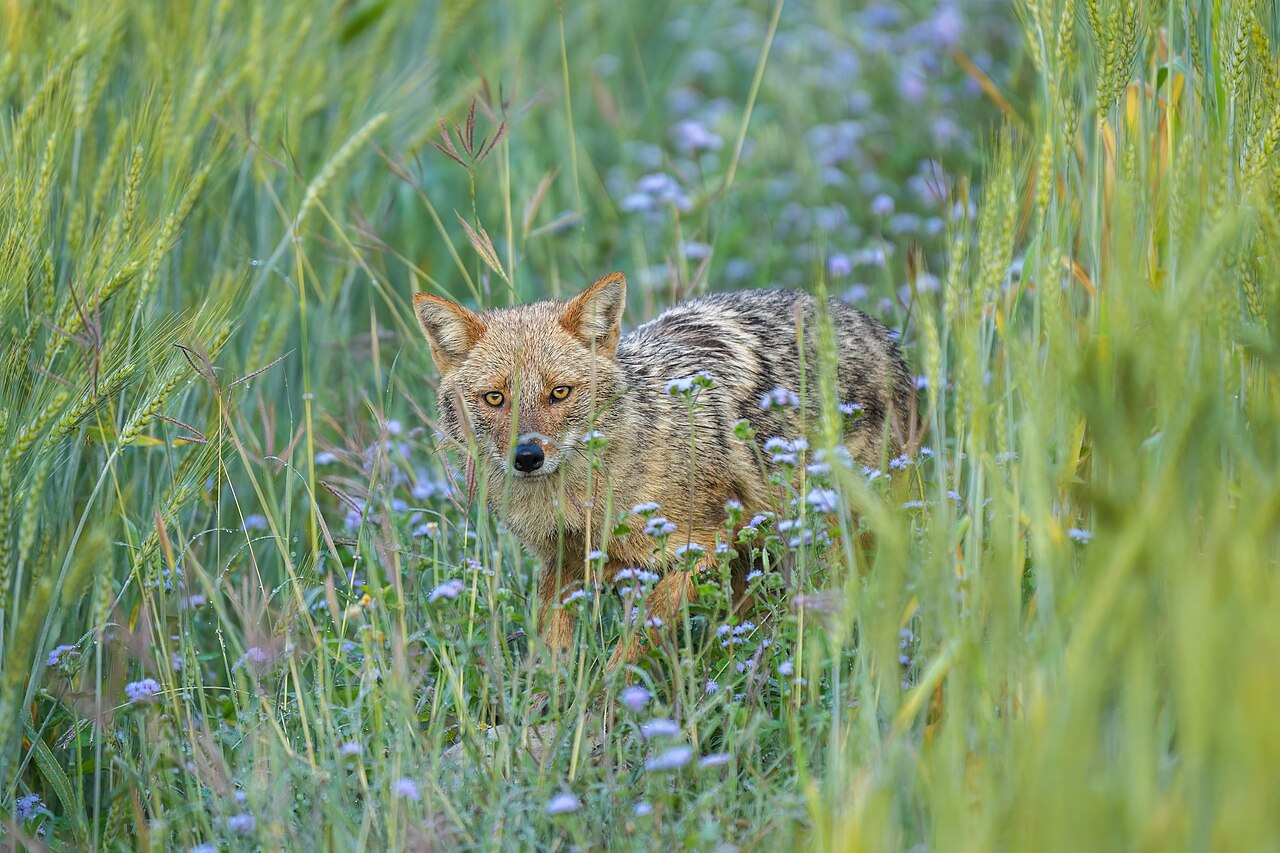
While North American LGD discussions focus on coyotes, the golden jackal is the ecological equivalent that LGD breeds were originally developed to combat. Breed profiles across the site's research database confirm this explicitly:
- Kangal (Turkey): “A formidable guardian, used to protect livestock from predators such as wolves, bears, jackals, and even cheetahs.”
- Greek Shepherd (Greece): “Renowned for its ability to guard flocks from predators such as wolves, jackals, and bears.”
- Armenian Gampr (Armenia): “Bred to protect livestock from large predators such as wolves, bears, leopards, and jackals.”
- Aidi (Morocco/Atlas Mountains): “Developed to protect flocks from a range of predators including wolves, jackals, bears, and wild boars.”
This is not a new threat — this is the original threat. Every Mediterranean, Anatolian, and Balkan LGD breed carries thousands of years of anti-jackal selection pressure.
Research-Documented LGD Effectiveness
Two peer-reviewed studies in the site's research database directly document LGD-vs-jackal interactions:
Jackal vs. Coyote: Key Differences
North American LGD owners should understand how jackals differ from coyotes:
- Size: Golden jackals (15–33 lbs) are significantly smaller than coyotes (20–50 lbs). A single LGD of any breed provides a decisive physical advantage.
- Bite force: ~200 PSI (jackal) vs. ~300 PSI (coyote) vs. ~743 PSI (LGD). The force differential is even more favorable against jackals than against coyotes.
- Pack behavior: Coyotes form larger hunting groups seasonally. Jackals typically operate as mated pairs with occasional helpers. Less pack coordination means less ability to run decoy-and-flank tactics.
- Wolf relationship: Both coyotes and jackals are suppressed by wolves. In areas where wolves return, jackal populations decline through intraguild predation. In wolf-free areas, jackal populations expand rapidly.
European Range Expansion
The golden jackal's northward expansion across Europe is one of the most significant wildlife developments of the 21st century. Historically confined to the Balkans, Turkey, and the Middle East, jackals have been confirmed in an expanding list of countries including Germany, Austria, France, the Netherlands, Denmark, Estonia, and Finland.
This expansion has major implications for European livestock producers who may never have dealt with a canid predator before. In regions where LGDs are not traditionally used (Scandinavia, the Low Countries), the arrival of jackals may drive new demand for guardian dogs — the same breeds that have been defending against this exact predator for millennia in their homelands.
Gavagnach, C., & Ben-Ami, D. (2023). Management and behavior of livestock guarding dogs in a multiuse rural landscape in northern Israel. Rangeland Ecology & Management. DOI: 10.1016/j.rama.2023.02.008.
Potgieter, G. C., Kerley, G., & Marker, L. (2016). More bark than bite? The role of livestock guarding dogs in predator control on Namibian farmlands. Oryx, 50(3). DOI: 10.1017/S0030605315000113.
Gopalakrishnan, S., et al. (2018). Interspecific gene flow shaped the evolution of the genus Canis. Current Biology, 28(21). DOI: 10.1016/j.cub.2018.08.041.
Guardians.dog Breed Research Database — Elicit Comprehensive Comparison of 56 Livestock Guardian Dog Breeds (2026). Internal compilation of peer-reviewed breed profiles.