Feral Swine (Wild Hogs)
America’s most destructive invasive species — and a growing threat to farms in 35+ states
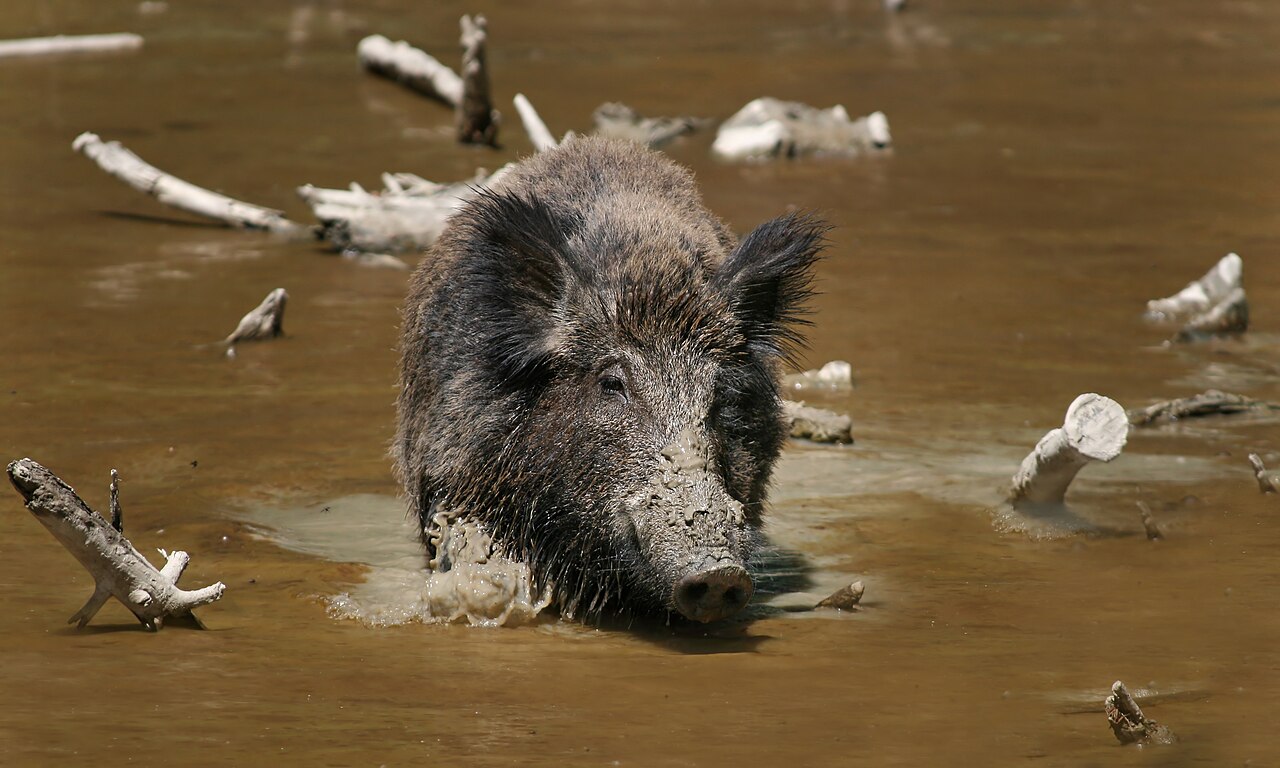
Feral swine (Sus scrofa) are the most destructive invasive species in the United States. With a population exceeding 6 million animals across 35+ states, wild hogs cause an estimated $1.5 to $2.5 billion in annual damage through crop destruction, pasture degradation, disease transmission, and predation on young livestock. Unlike most farm predators, feral swine eat everything — livestock, crops, feed stores, fencing, and even the ground itself.
Key Takeaways
- Invasive Devastation: Driven by illegal transport for hunting and rapid reproduction, the range of feral swine expanded from 17 states to 38 states in just 30 years, currently occupying over 1.7 million square kilometers.
- Disease Vectors: Wild hogs carry over 30 diseases transmissible to livestock and LGDs, most notably Pseudorabies (which is uniformly fatal to dogs), Brucellosis, and Leptospirosis.
- LGD Limitations: While LGDs can deter small groups or protect specific birthing areas, they cannot reliably stop large sounders (10+ hogs). Direct confrontation with an adult boar (200-400+ lbs, ~830 PSI bite force) is highly dangerous for any dog.
Feral Swine (Wild Hog) — Species Intelligence
Sus scrofaHybrid vigor — Today's wild pigs are a genetic mix of escaped domestic pigs (introduced by the Spanish in the 1500s) and Eurasian wild boars (imported for sport in the 1900s).
Sounders of 5–30+ — Matriarchal groups (sows + piglets). Boars are solitary except during breeding. Large sounders can overwhelm LGD deterrence.
5–6 piglets, up to 2x per year — The fastest-reproducing large mammal. 40–60% annual removal is needed just to hold numbers steady.
~830 PSI
+ tusks | vs. LGD: ~743 PSI
The Invasive Explosion Timeline
Feral swine are not native to the Americas. Their story is essentially the reverse of the wolf and bear recoveries — an unwanted population explosion rather than a hard-won comeback. Their spread is largely human-driven, propelled by the illegal transport of pigs for recreational hunting.
Introduction: Spanish explorers first brought domestic pigs as a food source in the 1500s. In the early 1900s, Eurasian wild boar were imported (notably into North Carolina) for sport hunting. Modern feral swine are a genetic mix of both lineages, which confers high hybrid fitness.
Contained Populations: Wild pigs were largely confined to 18 states, occupying an area of about 545,000 square kilometers, predominantly in Texas, California, and the deep South.
The Explosion: Over a 30-year span, the range expanded rapidly to 38 states, tripling in occupied area to nearly 1.7 million sq km. The rate of northward spread increased from 6.5 to 12.6 km per year, largely driven by the sale of hunting opportunities and game ranch operations.
Federal Intervention: The USDA established the National Feral Swine Damage Management Program (NFSDMP). This reduced the spread rate by 82%, preventing hogs from overtaking an estimated 724 additional counties and safeguarding $40 billion in agricultural resources.
How Feral Swine Damage Farms
Livestock Predation
- Young livestock: Feral hogs prey on newborn lambs, kids, piglets, and calves. They are omnivorous and opportunistic — they will kill and consume young animals when they encounter them.
- Carcass consumption: Wild hogs often consume the entire carcass, leaving little or no evidence of the kill. This makes confirming hog predation difficult compared to other predators.
- Nest destruction: Ground-nesting poultry (turkeys, guinea fowl) lose eggs and chicks to rooting hogs.
Crop & Pasture Destruction
- Rooting: Hogs root up pastures, hayfields, and crop fields with their powerful snouts, destroying ground cover and creating erosion. A sounder (group) of hogs can destroy acres of pasture in a single night.
- Crop consumption: A 2024 survey estimated nearly $700 million in losses from just six crops in eleven southeastern states alone.
- Feed contamination: Feral hogs break into feed storage, consuming and contaminating livestock feed with feces and urine.
Disease Transmission
LGDs and Feral Swine: Honest Assessment
LGDs provide limited but useful protection against feral swine. This is one area where expectations must be carefully managed. Recreational hunting is often counterproductive, as it scatters sounders; professional trapping is required.
| Capability | Effectiveness | Notes |
|---|---|---|
| Deterring single/small groups | MODERATE | LGD barking may deter small groups of 1–5 hogs from entering pastures |
| Deterring large sounders (10+) | LOW | Large groups of hogs are unlikely to be deterred by dogs alone |
| Direct confrontation | DANGEROUS | Adult boars (200–400+ lbs) with tusks can seriously injure or kill LGDs |
| Protecting birthing areas | GOOD | LGD presence near birthing areas deters opportunistic hog predation on newborns |
| Alarm function | GOOD | LGDs alert farmers to hog presence, enabling rapid response |
Feral Swine Defense Strategies
- Trapping: USDA Wildlife Services conducts corral trapping programs that can remove entire sounders. This is the most effective population management tool. Removing the first 99% of a population is cost-effective; the final 1% requires extreme precision.
- Fencing: Heavy-gauge panel fencing or reinforced electric fencing. Hogs can break through standard livestock fencing. Electric fencing with a low “nose wire” at 6 inches is moderately effective.
- Aerial removal: Helicopter-based shooting programs in states like Texas have removed hundreds of thousands of feral hogs.
- LGDs for birthing areas: Deploy LGDs in lambing/kidding/calving areas during vulnerable windows to deter opportunistic predation.
Bevins, S. N., et al. (2014). Consequences Associated with the Recent Range Expansion of Nonnative Feral Swine. BioScience.
Corn, J. L., & Jordan, T. R. (2017). Development of the national feral swine map, 1982-2016. Wildlife Society Bulletin.
Jareb, et al. (2024). Agricultural and Ecological Resources Safeguarded by the Prevention of Wild Pig Population Expansion. Biology.
Miller, R. S., et al. (2023). Transient population dynamics drive the spread of invasive wild pigs and reveal impacts of management in North America. Biological Invasions.
Smith, et al. (2023). Cultural and regulatory factors influence distribution and trajectory of invasive species in the United States: A wild pig case study. Journal of Environmental Management.
Smyser, T. J., et al. (2020). Mixed ancestry from wild and domestic lineages contributes to the rapid expansion of invasive feral swine. Molecular Ecology.
Snow, N. P., et al. (2017). Interpreting and predicting the spread of invasive wild pigs. Journal of Applied Ecology.