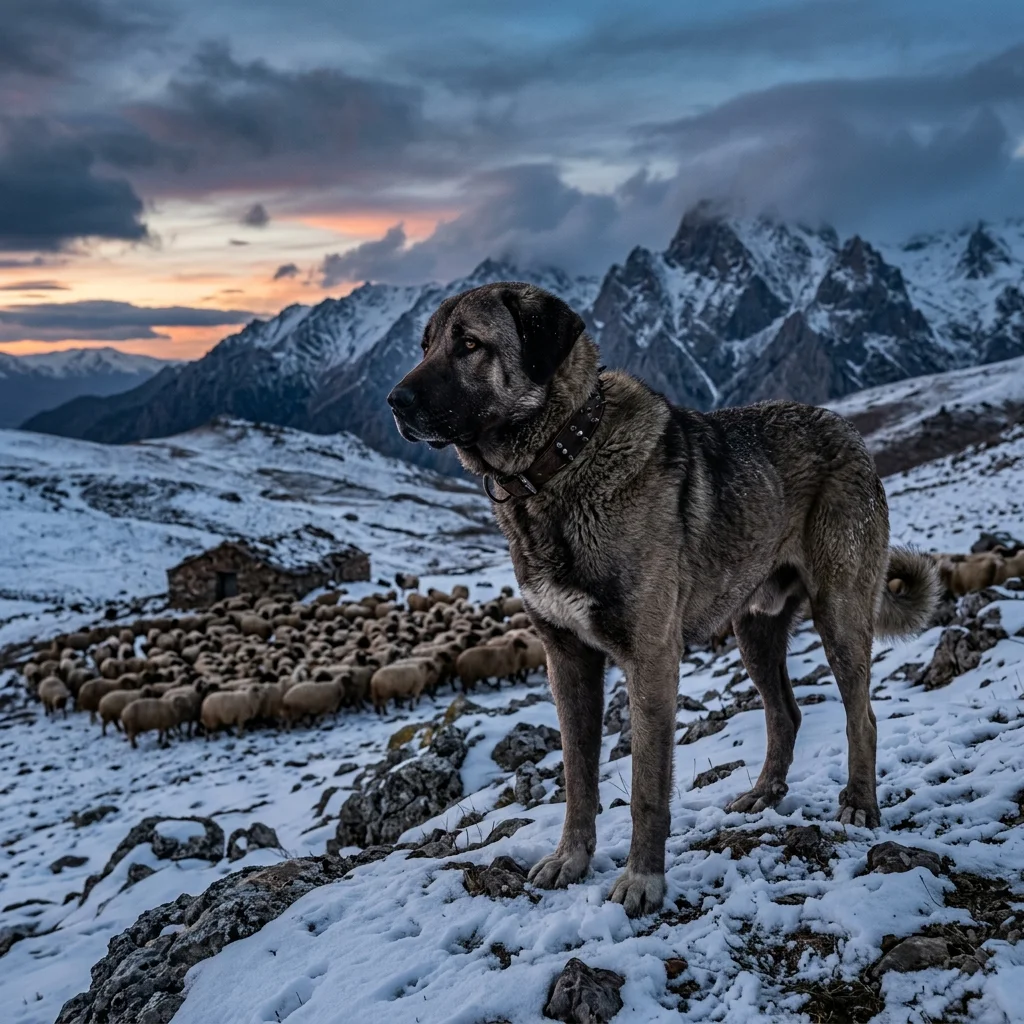
- Layered Defense: A single LGD is rarely enough against pack predators (wolves, feral swine); utilize multi-dog teams instead.
- Intimidation First: The primary job of an LGD is to deter threats through scent marking, barking, and posturing, not to seek out physical combat.
- Matching Threat Levels: The breed deployed must match the threat ecosystem (e.g., Kangals for wolves, Maremmas for aerial/small predators).
- Infrastructure Context: Even the strongest LGD cannot replace adequate physical fencing.
Reduction of Predation Losses
The primary benefit of LGDs is a significant reduction in livestock mortality. A survey in Colorado demonstrated the dramatic difference between producers using LGDs versus those without.
Lamb Losses to Predators (Relative Risk)
Source: Colorado Sheep Producer Survey (Andelt et al.)
Effectiveness Against Predators
LGDs are versatile defenders. While known for coyote control, they also repel larger threats.
- Coyotes: Highly effective. LGDs disrupt the "luring" behavior and ambition of packs.
- Bears & Cougars: Research indicates LGDs successfully repel black bears and mountain lions. Producers with dogs report significantly lower kill rates from these large carnivores.
- Domestic Dogs: Often the most dangerous threat, LGDs are excellent at repelling stray dogs.
Economic Benefits & ROI
While an LGD costs money to buy and feed, the Return on Investment (ROI) can be substantial. In one study of 125 producers, 392 dogs were estimated to save $891,440 in a single year.
Estimate Your Savings
Potential Annual Net Savings: $0
Operational and Management Benefits
How do LGDs compare to other methods?
| Method | Long-term Cost | Ecological Impact | Effectiveness |
|---|---|---|---|
| LGDs | Moderate (Food/Vet) | Positive (Non-lethal) | High (Increases with age) |
| Lethal Control | High (Repeating effort) | Negative | Temporary (Vacuum effect) |
| Frightening Devices | Low | None | Low (Habituation occurs) |
| Donkeys/Llamas | Moderate | Positive | Moderate (Vulnerable to packs) |
Limitations
LGDs are not perfect:
- Terrain: Rough terrain or thick cover gives predators an advantage.
- Interference: Dogs can be harmed by traps, snares, or poisons used for predator control.
- Training: Poorly bonded dogs may roam or harass livestock.
Breeds Cited
Research and farmers consistently cite specific breeds for their trustworthiness and protective instincts:
References
Musiani, Marco, Charles Mamo, Luigi Boitani, et al. ?Wolf Depredation Trends and the Use of Fladry Barriers to Protect Livestock in Western North America.? Conservation Biology 17, no. 6 (2003): 1538?47. https://doi.org/10.1111/j.1523-1739.2003.00063.x.
Degrazio, Johnw. WORLD BIRD DAMAGE PROBLEMS. n.d.
Young, J. K., J. Steuber, A. Few, A. Baca, and Z. Strong. ?When Strange Bedfellows Go All in: A Template for Implementing Non-lethal Strategies Aimed at Reducing Carnivore Predation of Livestock.? Animal Conservation 22, no. 3 (2019): 207?9. https://doi.org/10.1111/acv.12453.
Timm, Robert M., and Guy E. Connolly. ?Sheep-Killing Coyotes a Continuing Dilemma for Ranchers.? California Agriculture 55, no. 6 (2001): 26?32. https://doi.org/10.3733/ca.v055n06p26.
Connolly, Guy. Sheep and Goat Losses to Predators in the United States. n.d.
Hygnstrom, Scott E. Scott R. Craven University of Wisconsin-Madison. n.d.
Beasley, James C, and W Lafayette. Relationship between Raccoon Abundance and Crop Damage. n.d.
Groepper, Scott R., Scott E. Hygnstrom, Brandon Houck, and Stephen M. Vantassel. ?Real and Perceived Damage by Wild Turkeys: A Literature Review.? Journal of Integrated Pest Management 4, no. 1 (2013): 1?5. https://doi.org/10.1603/IPM12013.
Pearson, Erwin W., and Milton Caroline. ?Predator Control in Relation to Livestock Losses in Central Texas.? Journal of Range Management 34, no. 6 (1981): 435. https://doi.org/10.2307/3898093.
Leopold, A S, S A Cain, C M Cottam, I N Gabrielson, and T L Kimball. PREDATOR AND RODENT CONTROL IN THE UNITED STATES. n.d.
Stull, Daniel W, and Michael T Mengak. Managing Wildlife Damage: Coyote (Canis Latrans). n.d.
Pacific Geographical Institute, Russian Academy of Sciences, S.M. Govorushko, and Far Eastern Federal University. ?MAMMALS AND BIRDS AS AGRICULTURAL PESTS: A GLOBAL SITUATION.? Sel?skokhozyaistvennaya Biologiya, no. 6 (December 2014): 15?25. https://doi.org/10.15389/agrobiology.2014.6.15eng.
Andelt, William F., and Stuart N. Hopper. ?Livestock Guard Dogs Reduce Predation on Domestic Sheep in Colorado.? Journal of Range Management 53, no. 3 (2000): 259. https://doi.org/10.2307/4003429.
Avery, Michael L, and J L Cummings. Livestock Depredations by Black Vultures and Golden Eagles. n.d.
Gese, Eric M, Sean P Keenan, and Ann M Kitchen. LINES OF DEFENSE: Coping with Predators in the Rocky Mountain Region. n.d.
Dolbeer, Richard A, and Nicholas R Holler. IDENTIFICATION AND CONTROL OF WILDLIFE DAMAGE. n.d.
Dolbeer, Richard A, Nicholas R Holler, and Donald W Hawthorne. Identification and Assessment of Wildlife Damage: An Overview. n.d.
Gese, Eric M. Management of Carnivore Predation as a Means to Reduce Livestock Losses: The Study of Coyotes (Canis Latrans) in North America. n.d.
Seward, Nathan W, Kurt C VerCauteren, Gary W Witmer, and Richard M Engeman. Feral Swine Impacts on Agriculture and the Environment. n.d.
Campbell, Tyler A., and David B. Long. ?Feral Swine Damage and Damage Management in Forested Ecosystems.? Forest Ecology and Management 257, no. 12 (2009): 2319?26. https://doi.org/10.1016/j.foreco.2009.03.036.
Hutton, Thomas, Thomas J DeLiberto, Sheldon Owen, and Bruce Morrison. Disease Risks Associated with Increasing Feral Swine Numbers and Distribution in the United States. n.d.
Swanson, David A., Gerald E. Meyer, and Robert J. Stoll. ?CROP DAMAGE BY WILD TURKEY IN OHIO.? Wildlife Society Bulletin 2000, no. S1 (2000): 139?43. https://doi.org/10.1002/j.2328-5540.2000.tb00263.x.
Pugh, Brian. Chapter 13 Predator Control. n.d.
Andelt, W. F. (1992). Effectiveness of livestock guarding dogs for reducing predation on domestic sheep. Wildlife Society Bulletin.
Green, J. S., & Woodruff, R. A. (1988). Breed comparisons and characteristics of use of livestock guarding dogs. Journal of Range Management.
Coppinger, R., et al. (1988). A decade of use of livestock guarding dogs. Proceedings of the Vertebrate Pest Conference.
VerCauteren, K. C., et al. (2012). Livestock protection dogs in the 21st century. BioScience.