Key Takeaways
- Genetic Drive: Roaming is a hardwired territorial instinct — LGDs were selectively bred for centuries to patrol and expand perimeters, making it one of the most persistent behavioral traits in all guardian breeds.
- Bonding Reduces Range: Well-bonded dogs with strong livestock attachments show significantly smaller patrol radii than dogs with incomplete or weak livestock bonds.
- Intact Males Roam More: Studies on canine ranging behavior confirm that intact males have significantly larger home ranges, particularly during estrus cycles of nearby females, making neutering a legitimate management tool for non-breeding dogs.
Roaming Risk Self-Assessment
Check all that apply to your situation:
Risk Interpretation:
- 0-1 checked: Low risk ? Standard monitoring
- 2-3 checked: Moderate risk ? Increase vigilance, address gaps
- 3+ checked: High risk ? Immediate action required (fencing, supervision, management changes)
Why LGDs Roam
Roaming is an instinct-driven behavior shaped by thousands of years of selective breeding:
- Territory patrol: Natural guardian behavior to survey and mark boundaries
- Predator deterrence: Widening the defended area beyond the immediate property
- Breeding drive: Intact dogs (especially males) will travel miles to find mates
- Social connection: Seeking other dogs, especially if isolated
- Prey drive: Following wildlife scent trails
- Boredom/inadequate bonding: Dogs not properly bonded to livestock may wander
In traditional pastoral settings, roaming wasn't problematic?dogs moved with flocks across open land. Modern property boundaries and traffic create entirely different contexts.
Highest-Risk Factors
Some scenarios dramatically increase roaming likelihood:
Intact Males (18-36 months)
This demographic accounts for the majority of lost LGDs. Breeding drive peaks during sexual maturity and can override all other instincts. Even well-bonded dogs may leave.
Inadequate Fencing
Under 5 feet, chain-link only, or with gaps. LGDs are large, strong, and determined. What contains a pet dog often fails for working guardians.
Other Significant Risk Factors
- Poor livestock bonding: Dogs without proper attachment during critical periods (8-16 weeks)
- Small properties: <5 acres may not satisfy patrol instincts
- Single dogs: Isolation can drive seeking behavior
- Nearby intact females in heat: Can attract males from miles away
- New to property: First 6-12 months before territory is established
- High-ranging breeds: Some breed lines naturally cover more ground
Prevention Strategy Hierarchy
Effective roaming prevention uses multiple layers. No single strategy is 100% reliable:
Priority 1: Physical Containment
This is non-negotiable. Without secure perimeter fencing, eventual roaming is almost guaranteed.
- Minimum height: 5-6 feet for most breeds (some need higher)
- Fence type: Woven wire, high-tensile with minimal spacing, solid wood
- Dig prevention: Buried wire or "L" footer for diggers
- Gate security: Latches dogs cannot manipulate, auto-close springs
- Regular inspection: Weekly checks for damage, digging, weak points
Visual Fencing Guide
Understanding what works (and what doesn't) for LGD containment:
? Effective Fencing
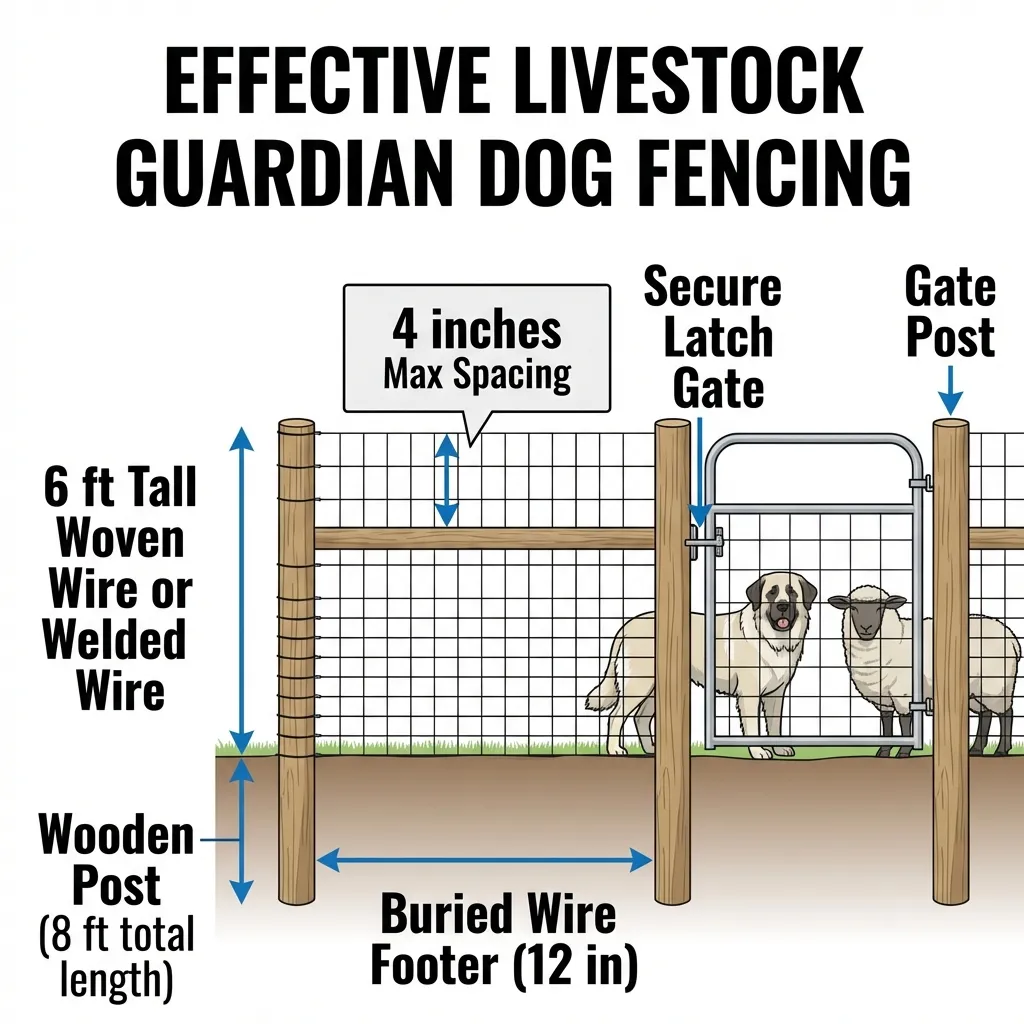
Minimum 6 ft height, woven/welded wire with 4" max spacing, buried footer to prevent digging, secure gate latches
? Ineffective Fencing
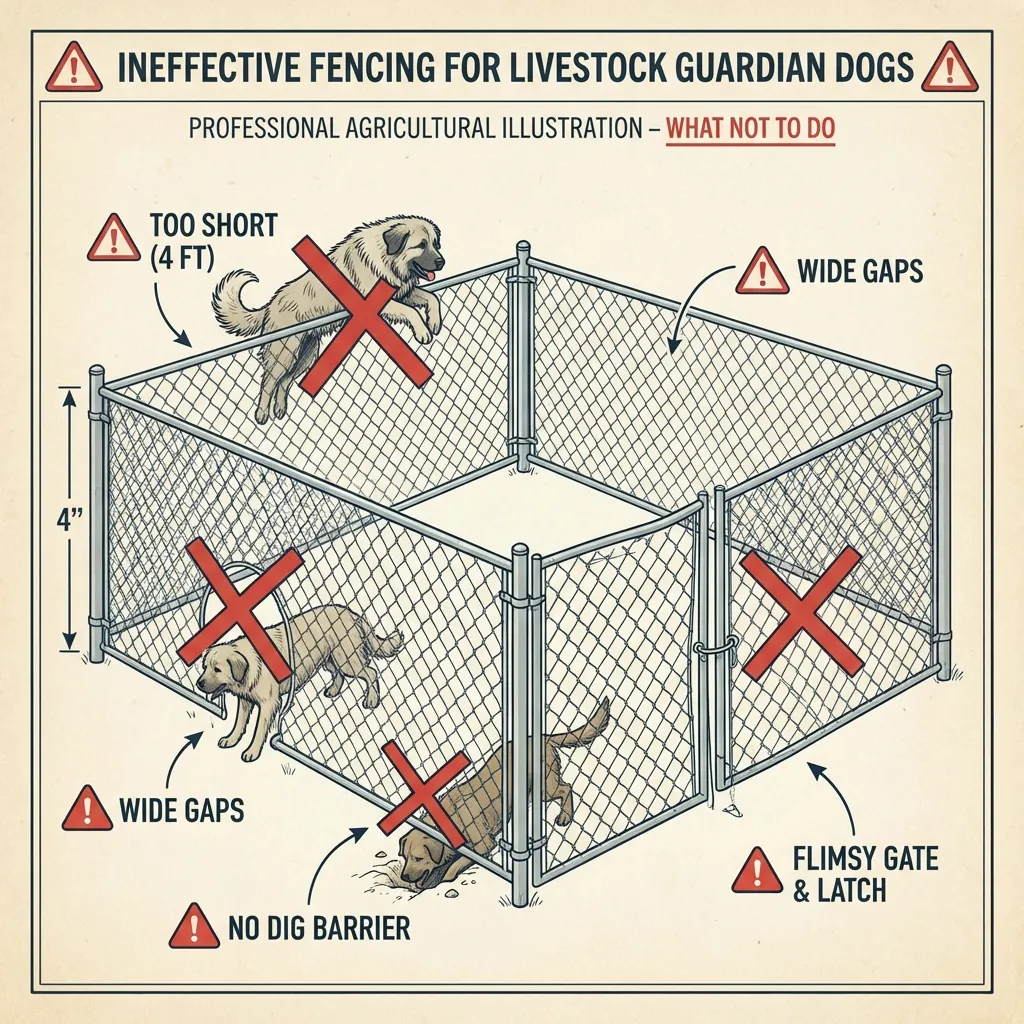
Under 5 ft, chain-link with large gaps, no underground barrier, flimsy latches ? common failures
Priority 2: Livestock Bonding
Dogs bonded to their charges during critical periods (8-16 weeks) are less likely to leave:
- Early introduction: Puppies with livestock from 8 weeks minimum
- Minimize human contact: During bonding period (see Bonding & Imprinting)
- Consistency: Dog lives with stock 24/7, not part-time
- Multi-species bonding: If guarding multiple species, introduce all early
Priority 3: Spay/Neuter Timing
This is complex and requires careful consideration:
- Benefits of altering: Dramatically reduces sex-driven roaming (up to 90% reduction in males)
- Skeletal maturity: Wait until 18-24 months for large breeds to allow proper bone development
- Working ability: Altering does not eliminate guardian instincts
- Male vs. female: Males benefit more in roaming reduction; females have heat-cycle management issues if intact
Priority 4: Guardian Partnerships
Multiple dogs can reduce anxiety-driven roaming:
- Social fulfillment: Reduces seeking of other dogs
- Territory coverage: Dogs can split patrol, reducing individual stress
- Same-sex pairs: Often work better than opposite-sex (reduces breeding behavior)
- Caution: Some dogs become "pack hunters" and may roam together
What Doesn't Typically Work
These approaches are often suggested but rarely effective for LGDs:
E-Collars & Invisible Fence
LGDs have high pain tolerance and strong drive. Most will blow through e-fence barriers when motivated (intact male scenting a female, predator pursuit, fear response).
- Containment failure: Once they learn barriers can be crossed, effectiveness drops
- Stress creation: Can cause barrier frustration, increased aggression
- No predator protection: Invisible fencing doesn't keep threats OUT
Training & Recall
LGDs are not programmed for obedience like herding or sporting breeds:
- Low recall reliability: Even well-trained LGDs may ignore commands when "working"
- Independent decision-making: Bred to work without human direction
- Distance from handler: Often too far to hear commands during patrol
Punishment After the Fact
Returning after roaming and then being punished teaches dogs to avoid coming back:
- Timing disconnect: Dogs don't connect punishment with roaming hours earlier
- Return avoidance: Makes retrieval harder
- Stress without learning: Creates anxiety without behavior change
Breed Variation in Roaming
Some breeds naturally range farther than others:
- Generally wider-ranging: Great Pyrenees, Akbash, some Central Asian lines
- More property-focused: Anatolian/Kangal, Maremma (though still require fencing)
- Variable: Depends heavily on individual lines and working style
Important: Breed tendencies are generalizations. Individual variation and management matter far more than breed alone.
When a Dog Goes Missing
Despite best prevention, roaming can happen. Act immediately:
First 24 Hours (Critical Window)
- Search property thoroughly: Dogs may be sleeping in unexpected spots
- Alert neighbors immediately: Provide photo, number, emphasize "working dog, may avoid strangers"
- Contact animal control: Report as missing, provide microchip info
- Check roads: Unfortunately, traffic is a major risk
- Post on local social media: Community groups, lost pet pages
- Leave scent articles: Your worn clothing at last-seen location
Printable Emergency Response Template
Fill this out before an emergency happens. Keep a copy with your vet records.
Name: _________________ Breed: _________________ Age: _____
Microchip #: _________________________ Registered to: _________________
Distinctive Markings: _________________________________________________
Your Vet: _____________________ Phone: _______________________
24hr Emergency Clinic: _______________ Phone: _______________________
Animal Control: ____________________ Phone: _______________________
Nearest Neighbor(s): ___________________ Phone: _______________________
? Search property thoroughly (barns, sheds, dense brush)
? Call neighbors within 2-mile radius
? Contact animal control & local shelters
? Post on Facebook: Lost Pets [Your County], Nextdoor, local groups
? Drive/walk roads checking for traffic incidents
? Leave worn clothing at last-seen location
? Set up trail camera(s) at property perimeter
Attach recent photo of dog to this document
Why LGDs Are Hard to Find
- Avoid strangers: Won't come to calling from unknown people
- Range widely: Can cover 10+ miles in a day
- Sleep during day: May be hidden and inactive when searchers are looking
- Self-sufficient: Can survive independently for extended periods
Livestock Considerations During Search
If your LGD was the primary guardian:
- Temporary measures: Bring stock closer to house/barn at night
- Increased monitoring: Check more frequently
- Backup plans: Have a neighbor or backup guardian arrangement ready
Green, J. S., & Woodruff, R. A. (1988). Breed comparisons and characteristics of use of livestock guarding dogs. Journal of Range Management.
Rigg, R. (2001). Livestock guarding dogs: their current use world wide. IUCN/SSC Canid Specialist Group Occasional Paper No. 1.
Andelt, W. F. (1992). Effectiveness of livestock guarding dogs for reducing predation on domestic sheep. Wildlife Society Bulletin.
VerCauteren, K. C., et al. (2012). Livestock protection dogs in the 21st century. BioScience.
Marker, L. L., et al. (2005). Aspects of the management of cheetahs trapped on Namibian farmlands. Biological Conservation.