Key Takeaways
- 3–14 weeks is the critical window: This is when primary socialization occurs and species attachment forms. Placement with livestock at 6–8 weeks is standard practice.
- Dual socialization is the core tension: LGDs must bond to both livestock AND tolerate humans—these goals can conflict during the same developmental window.
- Isolation elevates aggression risk: Dogs raised in sheepfolds with minimal human contact show significantly higher human-directed aggression than dogs raised with family contact.
- The adult dog is your best trainer: A well-socialized adult LGD will teach a puppy appropriate livestock behavior through modeling faster than any human protocol.
The Critical Period: What the Science Says
The concept of critical periods in canine social development was established by Scott (1958) and confirmed by Freedman et al. (1961), who demonstrated that puppies have a primary socialization window between approximately 3 and 14 weeks of age. During this window, puppies form primary social bonds with the species they're exposed to. After the window closes, novel social stimuli are more likely to trigger fear and avoidance rather than bonding.
Scott et al. (2004) later refined this to describe it not as a single "critical period" but as a series of sensitive periods during which different behavioral systems organize. Pluijmakers et al. (2003) emphasized that the window is not a hard cutoff but a gradient—socialization becomes progressively more difficult as the puppy ages, rather than impossible at a fixed date.
A large-scale 2025 study by Espinosa et al. (N = 4,497 dogs using C-BARQ behavioral assessment) found that adverse experiences in the first six months—including abuse, relinquishment, and isolation—significantly increased adult aggression and fearfulness. Critically, these effects varied systematically by breed, indicating gene-environment interaction rather than a purely experiential mechanism. For LGDs—breeds selected for centuries to act independently and react agonistically to novel threats—this means the early rearing environment may have breed-specific consequences that differ from companion breeds.
The Dual-Socialization Tension
For LGDs, the critical period question has a fundamentally different structure than for companion dogs. The goal is not simply adequate human socialization but dual socialization—to both livestock (essential for guarding function) and humans (essential for safety). These two goals can be in tension.
The Coppinger Framework
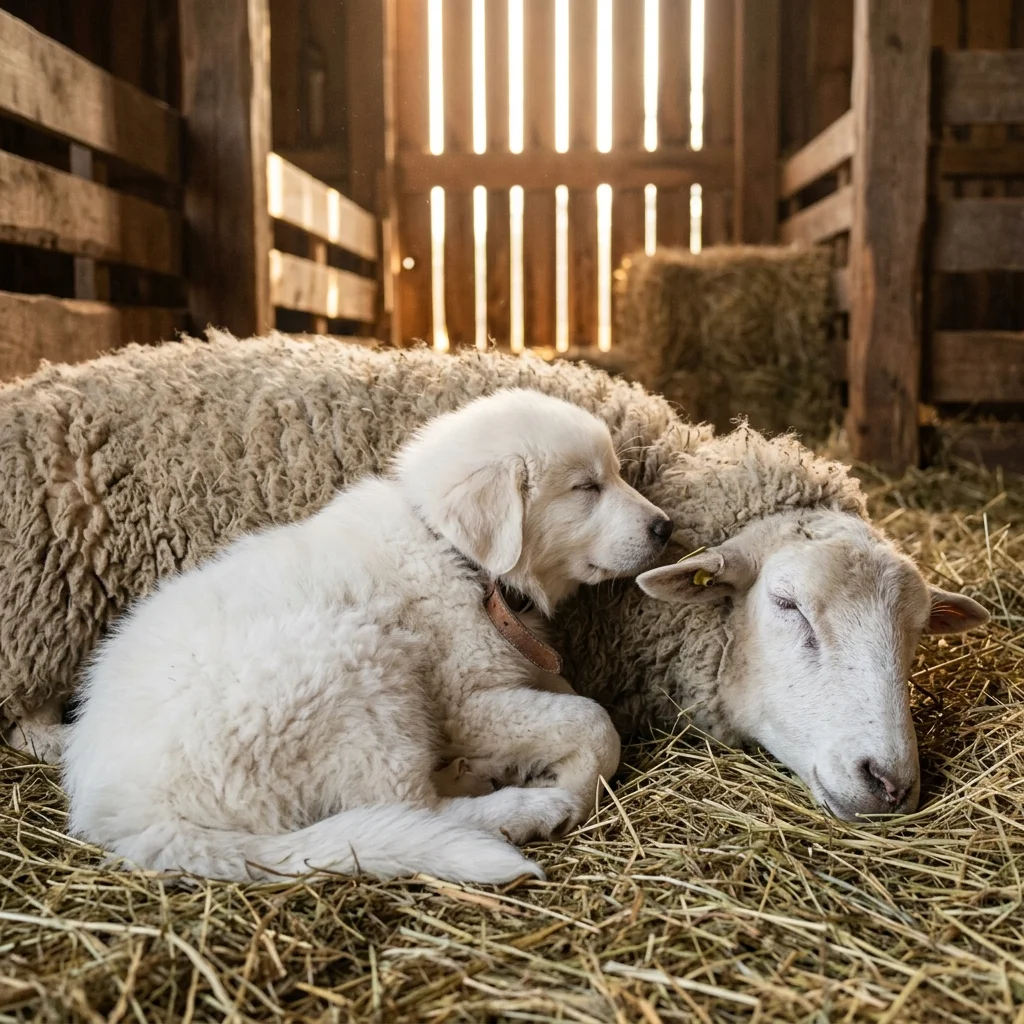
The Hampshire College Livestock Dog Project (1980s) established the dominant rearing protocol: place LGD pups with livestock at 6–8 weeks, before the fear period consolidates, and keep human contact minimal so the dog bonds to the livestock rather than to people.
The traditional implementation: put the pup in with sheep at 6–8 weeks, feed it while it is in the band, and actively discourage the dog from approaching handlers—the dog is "broken to sheep" first, then the human is accepted as a secondary presence.
The Problem with Pure Isolation
Marion et al. (2018), studying 28 LGDs in the Haute-Savoie French Alps, produced the most direct empirical challenge to the minimal-contact approach. Their finding: dogs raised in sheepfolds isolated from humans showed significantly higher human-directed aggression risk than dogs raised in contact with family.
This is not a theoretical concern. In the modern landscape—where LGDs routinely encounter hikers, tourists, veterinarians, and farm workers—a dog that is aggressive toward all humans is a liability, not an asset. The Marion study directly challenges the old protocol, at least for contexts where human encounters are unavoidable.
The implication is a socialization allocation problem: the same weeks that are optimal for livestock bonding (6–14 weeks) are the same weeks that are critical for human socialization. Rearing in a sheepfold achieves the livestock bond but at the cost of human habituation. Rearing in family contact achieves human socialization but may produce dogs with weaker or slower-developing livestock bonds.
The Modern Protocol: Structured Dual Exposure
Extension and practitioner documents from Ontario OMAFRA, Oregon State University, and others now recommend a middle path: place pups with livestock at 6–8 weeks but maintain regular, calm human contact specifically for handling purposes—health checks, hoof trimming, ear cleaning—without encouraging the dog to seek human company or leave the livestock.
The key distinction: handling contact is not socialization as play. The human interaction should be calm, purposeful, and brief. The puppy learns that humans are safe and predictable without learning that humans are the primary source of social reward.
Step-by-Step Introduction Protocol
Phase 1: Scent Exchange (Days 1–3)
Before any visual contact between the puppy and the adult dog, swap bedding between them so they become familiar with each other's scent. Place the puppy's blanket in the adult dog's sleeping area and vice versa. This allows both dogs to process the other's identity without the stress of a physical encounter.
What you're watching for: The adult dog should sniff the puppy's bedding with curiosity, not sustained stiff-bodied alertness or growling. If the adult reacts aggressively to the scent alone, slow the process down.
Phase 2: Fence-Line Introduction (Days 3–7)
Allow the puppy and adult dog to meet through a secure fence. Monitor body language carefully:
- Good signs: Relaxed postures, play bows, calm curiosity, soft eyes, mutual sniffing through the fence
- Warning signs: Stiff posture, hard stares, raised hackles, lip curling, lunging at the fence
Sessions should be 15–20 minutes, 2–3 times per day. End each session before either dog becomes overstimulated.
Phase 3: Supervised Direct Contact (Days 7–14)
When fence-line interactions are consistently calm, allow supervised off-leash contact in a neutral area—neither the adult's established territory nor the puppy's pen. Keep sessions short (15–30 minutes). Have a second person present to separate the dogs if needed.
Normal behavior: The adult dog will likely pin the puppy, stand over it, and enforce submission. This is not aggression—it's normal hierarchical communication. The puppy should respond by going limp, rolling onto its back, and licking the adult's mouth. Intervene only if the adult makes sustained, hard contact (biting with jaw pressure, shaking, or refusing to release).
Phase 4: Shared Livestock Space (Weeks 2–4)
Once interactions are reliably positive, allow shared access to the livestock area under supervision. This is where the adult dog becomes the puppy's primary teacher.
The adult will model appropriate livestock behavior through several mechanisms:
- Redirecting chase behavior: When the puppy chases a lamb, the adult may physically block or correct the puppy
- Patrol modeling: The puppy will begin following the adult on perimeter patrols, learning the territorial boundaries
- Response calibration: The puppy observes when the adult alerts to a threat vs. when it ignores a stimulus, learning appropriate response thresholds
Giant Breed Considerations
Adult-Puppy Cohabitation Risk
Giant breed adult LGDs (100–180 lbs) can unintentionally kill or seriously injure an 8–12 week old puppy (10–20 lbs) through normal rough play. A single paw step, a body check, or an over-enthusiastic correction can fracture a puppy's ribs, skull, or spine.
Until the puppy reaches approximately 30–40 lbs (typically 14–18 weeks), all direct contact with adult dogs should be supervised. Never leave a puppy unsupervised with an adult that outweighs it by more than 5:1.
Lorenz et al. (1986) found that "inappropriate behavior" accounted for about a third of pre-senile LGD deaths through culling. While the specific behaviors aren't broken down, the implication is clear: poorly socialized dogs don't just fail—they die. Getting the introduction and socialization right during the first 14 weeks is the single highest-ROI investment you can make in a working dog's career.
What the Evidence Supports (and What It Doesn't)
- Well-supported: The 3–14 week primary socialization window in dogs generally
- Well-supported: The 6–8 week livestock introduction recommendation (Coppinger framework + decades of practitioner experience)
- Empirically demonstrated: Sheepfold isolation elevates human-directed aggression (Marion et al., 2018, N=28)
- Demonstrated: Early adversity effects are breed-modulated (Espinosa et al., 2025, N=4,497)
- NOT demonstrated: The specific contact duration threshold (e.g., "40 minutes/week") that balances livestock bonding with human socialization
- NOT demonstrated: Controlled comparative trials of LGD rearing protocols with adult behavioral outcomes
The single biggest gap in this literature: a prospective study randomly assigning LGD litters to rearing conditions with different human-to-livestock contact ratios and tracking adult behavioral outcomes (aggression, attentiveness, trustworthiness) would directly answer the question that practitioners most need answered.
Scott, J. P. (1958). Critical Periods in the Development of Social Behavior in Puppies. Psychosomatic Medicine, 20(1), 42–54.
Freedman, D. G. et al. (1961). Critical Period in the Social Development of Dogs. Science, 133(3457), 1016–1017.
Scott, J. P. et al. (2004). Critical periods in the organization of systems. Developmental Psychobiology.
Pluijmakers, J. J. T. M. et al. (2003). Sensitive Periods in the Development of Behavioural Organization in the Dog and the Role of Emotional Homeostasis.
Majecka, K. et al. (2019). Conditions during sensitive periods of early behavioural development in dogs (Canis lupus familiaris).
Espinosa, J. et al. (2025). Influence of early life adversity and breed on aggression and fear in dogs. Scientific Reports.
Coppinger, R. et al. (1987). New Uses of Livestock Guarding Dogs to Reduce Agriculture/Wildlife Conflicts.
Bilodeaux, L. (1993). Guarding sheep: it's a dog's world. Rangelands Archives.
Marion, S. et al. (2018). Study of aggressiveness in livestock-guarding dogs based on rearing method. Journal of Veterinary Behavior.
Gehring, T. M. et al. (2011). Good fences make good neighbors: implementation of electric fencing for establishing effective livestock-protection dogs.
Urbigkit, C. (2019). Livestock Guardian Dogs and Cattle Protection: Opportunities, Challenges, and Methods. Human-Wildlife Interactions.
Sablik, P. et al. (2025). The Impact of Herding and Guardian Dogs on the Behaviour and Welfare of Sheep. Acta Scientiarum Polonorum Zootechnica.
Cohen, S. (2017). A Longitudinal Study of Maternal Style, Young Adult Temperament and Cognition, and Program Outcome in Guide Dogs. Doctoral dissertation.
Lorenz, J. R. et al. (1986). Causes and Economic Effects of Mortality in Livestock Guarding Dogs. Journal of Range Management, 39(4), 293–295.