The Tibetan Mastiff: Cultural Heritage
Key Takeaways
- Ancient Lineage: The Tibetan Mastiff represents one of the oldest guardian dog lineages, with genetic studies placing its divergence from other breeds at over 5,000 years ago.
- Altitude Adaptation: Tibetan Mastiffs carry unique genetic adaptations for high-altitude survival, including enhanced oxygen metabolism — traits shared with Tibetan human populations.
- Market Distortion: The Chinese luxury market bubble (2010s) inflated Tibetan Mastiff prices to millions of dollars, creating breeding-for-profit incentives that damaged working line integrity.
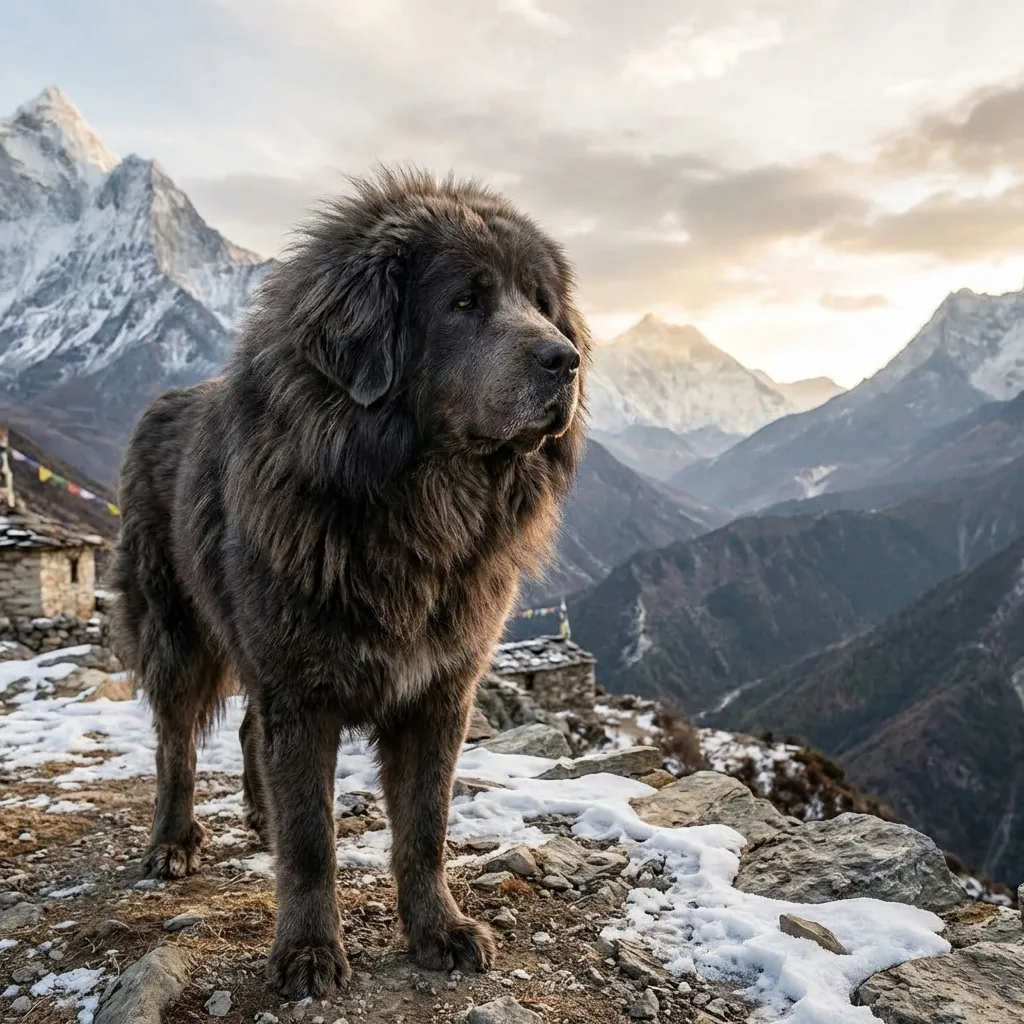
A 24-month ethnographic study reveals what happens when an ancient guardian bond is reduced to a price tag on aggression.
Illustration inspired by fieldwork documented in Zhou (2023). The Tibetan Plateau, ~4,500m elevation.The Study
Anthropologist Yufei Zhou conducted 24 months of fieldwork (2017–2020) across Lhasa, southern Gansu, and northern Sichuan, living alongside both Tibetan pastoral nomads (drokpa) and commercial Tibetan Mastiff breeders. The resulting paper, published by Cambridge University Press in 2023, documents a devastating contrast between two approaches to the same breed.
Source: Zhou, “Raising Dogs that Bite: How Pastoralists and Breeders Care for Tibetan Mastiffs,” Cambridge University Press (2023)
Two Systems, One Breed
The Pastoral Model
Among Tibetan drokpa, dogs participate in a reciprocal, distanced care relationship. The pastoralist provides food and space; the dog provides protection. There is no training in the Western sense—the dog is trusted to know its role innately.
The most valued guardian dogs are called xokyeng: mild, attentive, energetic, and hard-working. They switch into attack mode only when real threats appear. A xokyeng dog will sleep peacefully among the yak herd all day, then patrol the perimeter all night without prompting.
Key insight: The pastoral model selects for discernment—the ability to distinguish a genuine threat from a harmless visitor. This is the defining trait of the Warrior.
The Commercial Model
The “Tibetan Mastiff Fever” (zǎngáo rè, 藏獦热) of the Chinese commercial market prizes ferocity as a commodity. Breeders raise dogs that are uniformly aggressive, producing animals that regularly attack their own handlers.
Dogs are priced by weight, head size, and perceived ferocity. A single dog reportedly sold for $1.5 million at the market’s peak. The ethical dimension—the dog’s guarding as a moral virtue—is stripped away and replaced by a price tag on raw aggression.
Key insight: When ferocity becomes the selection criterion, you get a weapon without discipline. This is the opposite of a Warrior.
The Janzhek Case Study
Zhou documents a specific dog named Janzhek who appeared lazy and ineffective to an outside observer—he never barked at the researcher, wandered freely, and seemed to sleep all day. Yet when Zhou’s host walked outside at night and shouted the Tibetan-style hallooing (gegyen), Janzhek immediately transformed: ears forward, body tense, scanning the darkness.
Janzhek was not lazy. He was conserving energy for real threats. He had learned, through generations of pastoral selection, that barking at every visitor is a waste. The true guardian reserves its response for the moment it matters.
Why This Matters
The Warrior Definition, Refined
The Tibetan Mastiff case proves that the “Warrior” designation is not about aggression. It is about ethical guardianship. The three defining traits are:
- Discernment — the ability to distinguish threat from non-threat
- Restraint — the discipline to remain calm when no threat exists
- Commitment — the willingness to escalate to lethal force when the flock is genuinely threatened
A dog that attacks everything is not brave. A dog that attacks nothing is not useful. The Warrior is the dog that knows the difference.