From Scavengers to State Assets
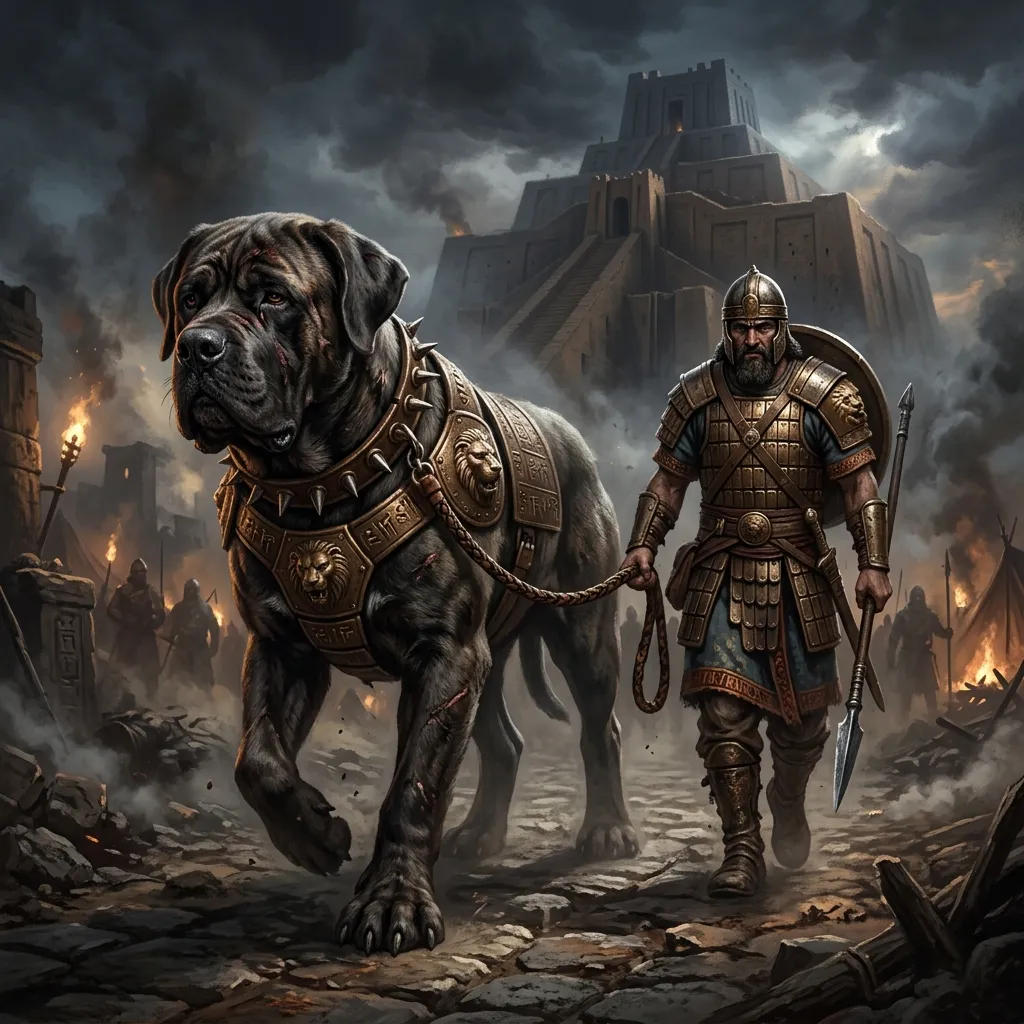
The transition of the dog from an opportunistic scavenger outside Neolithic camps to a state-managed military and agricultural asset represents a profound shift in human civilization. In the ancient Near East, specifically within the cradle of civilization between the Tigris and Euphrates rivers, the working dog evolved into a highly specialized, heavily armored beast of war and defense.
Unlike the lighter, faster coursing hounds developed elsewhere, the Mesopotamian paradigm required sheer stopping power—a massive, biomechanically superior animal capable of defending state assets against lions, bears, and hostile raiders.
The archaeological evidence spans over 10,000 years. Natufian wolf/dog remains from the Levant (c. 12,000 BP) show dental and cranial measurements consistent with early domestication. By the Neolithic period, soil from a dog pelvic bone at East Chia Sabz in western Iran (c. 8100 BCE) produced ascarid and taeniid parasite eggs—confirming that dogs were living in close enough proximity to humans to share their parasites. At Çatalhöyük in Anatolia, dogs "served as sentries and garbage processors," establishing the dual-purpose working role that Mesopotamian civilizations would later formalize into state institutions.
The Prehistoric Blueprint: Shuwaymis Rock Art
The Earliest Leashes
Before the rise of Sumerian empires, the foundational relationship between humans, dogs, and predators was being cemented. The Shuwaymis rock art in northwestern Saudi Arabia (dating to approximately 8,000–9,000 years ago) provides the earliest known visual evidence of humans utilizing specialized, leash-trained canine packs.
These depictions show distinctively marked dogs with pricked ears and curled tails—resembling modern Canaan dogs or early Basenji-types—assisting hunters in taking down wild equids and predators. This proves that the psychological foundation of canine obedience and cooperative defense was well-established millennia before the first ziggurats were built.
Dogs in Sumerian Daily Life
The Sumerian word for dog was ur-gi, and dogs served primarily as herders and guardians of dwellings. Two main morphological types appear across the archaeological and textual evidence: large greyhound-like hunting dogs (likely Saluki ancestors—a golden Saluki pendant from Uruk dates to approximately 3300 BCE) and heavy mastiff-type dogs used to guard flocks against wolves.
Idan Breier's study of Sumerian proverbial literature reveals that dogs appear frequently and with remarkable ambivalence—sometimes mischievous scavengers, sometimes valued workers. Several proverbs survive in translation:
“A begging dog goes from house to house.”
“The dog eats things defiling! The dog does not leave any food for the next morning.”
“Dogs at their… wait for instruction: ‘Where has it gone?’ ‘Bring it back!’ ‘Stay where you are!’”
“In a city of no dogs, the fox is overseer.”
That last proverb is particularly revealing: it frames the dog as a necessary enforcer of order—without dogs, the trickster fox rules. Another fox proverb reinforces this: a braggart fox planning to attack the city of Uruk is scared off when "the city dogs began to howl." Even 4,000 years ago, the guardian dog's voice was recognized as its primary weapon.
The Ur III K-9 Corps (2112–2004 BCE)
By the time of the Third Dynasty of Ur, the working dog had elevated from a tribal companion to a vital military asset. Administrative cuneiform tablets from the period reveal an incredibly detailed, state-managed bureaucracy dedicated exclusively to the breeding, feeding, and deployment of specialized canines.
This is arguably the first documented "K-9 Corps" in human history. Tsouparopoulou's close reading of administrative texts from the Drehem (Puzriš-Dagan) livestock archive provides "evidence that dogs were indeed used in the Ur III military." The state maintained meticulous records of rations distributed to dog handlers (sipa ur-gi7-ra) and the dietary needs of the dogs themselves, which were often fed premium cuts of meat, barley, and specialized broths to maintain peak physical condition.
"Fierce Lions" vs. Standard Forms
According to recently translated administrative texts, the Mesopotamian state categorized working dogs violently and practically. Foremost among these were the ur-mah (Fierce Lions) or massive mastiff-type dogs used for perimeter defense, lion hunting, and infantry shock tactics.
These early mastiffs were biologically distinct from the lighter sight hounds used for coursing prey. They possessed brachycephalic to mesocephalic craniums designed for crushing bite force, heavily muscled forequarters, and were frequently depicted wearing thick protective neck collars (the precursors to modern spiked wolf collars).
The Healing Goddess Gula
One of the most distinctive Sumerian/Mesopotamian associations was between dogs and the healing goddess Gula (also known as Nin-Isina). Böck's comprehensive study describes Gula as "the great physician" who "revives the dead" and notes that "one of the most intriguing features of Gula is her connection with a dog."
Tsouparopoulou traced this association back to the Ur III period using administrative texts from the livestock archive at Puzriš-Dagan, making it the earliest documented link between the healing goddess, dogs, and physicians in Mesopotamian civilization. Dog saliva was considered medicinal—an observation likely derived from watching dogs lick their wounds.
Inscribed clay dog figurines were dedicated to Gula and placed in temples, while other dog figurines served apotropaic (protective) purposes, buried under building thresholds to ward off evil. Corfù and Oelsner's study of these inscribed figurines distinguishes two categories: "a) Figurines in connection with the healing goddess Gula, b) Apotropaic figurines," noting that the apotropaic inscriptions often correspond closely to ritual texts prescribing the burial of protective dog images.
Rabid Dogs & Demonic Associations
Wu Yuhong's study in the Journal of the American Oriental Society documents the darker side of the Mesopotamian canine relationship. The Sumerians recognized what was almost certainly rabies—ur-idim in Sumerian, kalbu ṣegum ("rabid dog") in Akkadian—making this one of the earliest clinical descriptions of any disease in human history.
Cuneiform texts reveal a sophisticated, multi-layered response to rabies:
- Incantations against the rabid dog, recited as prophylactic measures
- Astrological omens predicting rabies epidemics based on celestial observations
- Behavioral omens interpreting a rabies outbreak as a sign of disaster for a city
- Proverbs using the rabid dog as a metaphor for evil or dangerous people
Religious texts placed the rabid dog among the monsters of Tiamat, and royal inscriptions depicted the "demon of the rabid dog" on palace doors and gates. This duality—the dog as both healer (through Gula) and destroyer (through rabies)—defined the Mesopotamian canine worldview.
Dogs in Mythology & Art
In the Epic of Gilgamesh, the goddess Innana (Ishtar) travels with seven hunting dogs in collar and leash—possibly the earliest literary depiction of leashed dogs in world literature. Chalendar's 2024 study explores this duality further, examining how the dog occupied a space "between cohabitation and confrontation" in the Mesopotamian symbolic repertoire.
By the Middle Assyrian period (mid-2nd millennium BCE), a specific guard dog phenotype had been formalized in art. A Middle Assyrian seal impression described by Parker shows "a large dog" identified as "a typical breed of Assyrian guard dog, with pointed nose, pointed ears, thick neck and curly tail." These same guard dogs were reproduced in bronze and buried under floors "to contend against supernatural enemies."
Neo-Assyrian letters from the 7th century BCE show the dog image as "ambivalent, denoting both its loyalty and submission and its potential for violence"—an assessment that any modern LGD owner would immediately recognize.
The Babylonian "House of the Dog"
As the Sumerian cultural influence transitioned into the Babylonian empire (c. 1894–1595 BCE), the institutional reverence for the guardian dog continued. The Babylonians established literal institutions known as the É-ur-gi7-ra, or the "House of the Dog."
Far from simply being dog pounds, these were state-funded veterinary and breeding centers. They operated under the purview of specific temples or provincial governors, ensuring an uninterrupted supply of war dogs, lion hunters, and livestock guardians for the expanding empire's agricultural estates.
A zooarchaeological study by Price et al. in the Journal of Field Archaeology also found evidence that some ancient Near Eastern communities processed dog carcasses for hides and possibly food—a finding the authors note is often underreported due to modern taboos. Whether this extended to Sumerian cities specifically remains unclear from the current evidence.
This 4,000-year-old genetic lineage of heavy, fearless guardians laid the foundational morphotype for the legendary Kuvasz, the towering Caucasian Shepherds, and the modern Kangal—proving that the requirement for a massive, unyielding guardian is as old as agriculture itself.
Mark, J. J. (2019). Dogs in the Ancient World. World History Encyclopedia.
Owen, D. (2013). Of Dogs and (Kennel)Men. Cuneiform Studies.
Breier, I. (2014). Sumer as the Cradle of History—Canine as Well: The Representation of the Dog in Sumerian Proverbial Literature. Maarav.
Childress, L. (2021). Sumerian Animal Proverbs (1700 BCE).
Böck, B. (2014). The Healing Goddess Gula: A Portrait. Die babylonisch-assyrische Medizin in Texten und Untersuchungen.
Tsouparopoulou, C. (2020). The Healing Goddess, Her Dogs and Physicians in Late Third Millennium BC Mesopotamia. Zeitschrift für Assyriologie und vorderasiatische Archäologie.
Tsouparopoulou, C. (2012). The "K-9 Corps" of the Third Dynasty of Ur: The Dog Handlers at Drehem and the Army. Zeitschrift für Assyriologie und Vorderasiatische Archäologie.
Corfù, N. A. & Oelsner, J. (2018). Beschriftete Hundestatuetten aus Mesopotamien. Text and Image.
Yuhong, W. (2001). Rabies and Rabid Dogs in Sumerian and Akkadian Literature. Journal of the American Oriental Society, 121(1).
Chalendar, V. (2024). Entre cohabitation & confrontation: le chien en Mésopotamie. Archimède.
Price, M. D. et al. (2020). Canine Economies of the Ancient Near East and Eastern Mediterranean. Journal of Field Archaeology.
Paknezhad, N. et al. (2017). Retrieving ascarid and taeniid eggs from the biological remains of a Neolithic dog (8100 BC) in Western Iran. Memórias do Instituto Oswaldo Cruz.
Russell, N. (2020). Scavenger and Sentry. Dogs.
Parker, B. (1974). A Middle Assyrian Seal Impression. Iraq.
Vilela, A. (2018). The complexity of the dog's supernatural symbolism in Ancient Mesopotamia.