Commercial Kibble: The Practical Standard
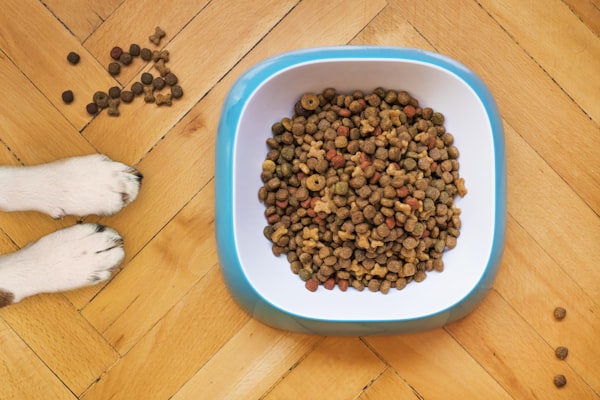
For most working LGD operations, quality commercial kibble is the most defensible feeding strategy. Here’s why:
- Complete & balanced by design: AAFCO-compliant foods are formulated to meet all macro/micronutrient requirements. No supplementation math required.
- Storage stability: Kibble stores for months without refrigeration — critical for remote pasture operations without electricity.
- Consistent nutrition: Every meal delivers the same nutrient profile. No seasonal variability.
- Biosecurity: No raw pathogen risk to livestock, handlers, or the dog.
- Cost predictability: Fixed cost per pound vs variable raw sourcing.
What to Look For
- AAFCO statement must say “including growth of large size dogs” for puppies under 24 months
- Named protein source as first ingredient (not “meat meal” or “animal byproduct”)
- Calcium 1.0–1.5% for adults; 1.0–1.2% for giant breed puppies
- Caloric density 3,200–4,100 kcal/kg (avoid ultra-high-calorie “performance” formulas for non-sprint dogs)
Raw Feeding: Risks Specific to LGDs
Behavioral Risk: Blood Taste Association
The “bloodthirsty myth” — that feeding raw meat makes dogs attack livestock — is overstated in its strongest form. Well-bonded LGDs with proper socialization do not suddenly become predators because they ate raw chicken. However, the nuance matters:
- Feeding raw meat in the pasture near livestock can trigger resource guarding behavior, which may redirect toward animals that approach during feeding
- Loose raw meat or bones in the field attract coyotes, foxes, and raptors — the exact predators your LGD is supposed to deter
- Young or poorly bonded dogs may develop chase/grab behaviors around raw meat that generalize to small livestock (kids, lambs, poultry)
Pathogen & Biosecurity Risk
Raw meat carries documented pathogen loads that affect the dog, the livestock, and human handlers:
- Salmonella: Dogs fed raw diets shed Salmonella in feces at significantly higher rates than kibble-fed dogs. Those feces contaminate pasture where livestock graze.
- E. coli: Raw meat surfaces harbor pathogenic E. coli strains that survive the canine GI tract.
- Echinococcus: Feeding raw offal (especially liver, lungs) from sheep perpetuates the dog–sheep hydatid disease cycle. See our Zoonotic Disease page.
- Neospora: Raw beef can transmit Neospora caninum, which causes abortion storms in cattle. Dogs are the definitive host.
Nutritional Completeness Risk
Home-formulated raw diets are frequently nutritionally incomplete:
- Most raw diets are calcium-deficient unless bones are ground and included at correct ratios (the raw Ca:P must stay between 1:1 and 2:1)
- Zinc and copper are commonly deficient without organ meat or supplementation
- Vitamin D is absent in muscle meat — must come from liver, oily fish, or supplementation
- Home-prepared and raw diets are explicitly discouraged for growing puppies by veterinary nutrition guidelines
The Raw Egg Question
Raw eggs are one of the most commonly fed farm supplements. The evidence is nuanced:
| Factor | Evidence |
|---|---|
| Avidin in raw egg whites | Binds biotin with extremely high affinity (Kd ≈ 10−15 M). Each raw egg white inactivates ~20 μg of biotin. |
| Deficiency threshold | Some studies involving smaller dogs have linked raw egg white consumption with a higher likelihood of diarrhea. Chronic exposure (months) produced scurfy skin, grey coat, and hyperkeratosis. |
| Cooking reduces risk | Cooking may reduce this risk because heat can reduce the activity of avidin in egg whites. Frying retains ~33% activity. Poaching retains ~71%. |
| Whole egg vs white only | Yolk contains high biotin concentration, partially offsetting avidin. Risk is highest when feeding whites alone. |
| Giant breed guideline | Consult your veterinarian or a canine nutritionist for appropriate amounts for a giant breed dog. Avoid daily raw-white-only feeding. Cook eggs if feeding >2/day. |
The “Bloodthirsty” Myth
The fear that feeding raw meat “teaches” a dog to kill livestock is not supported by behavioral research. Predatory behavior in dogs is driven by genetics (prey drive), socialization (or lack thereof), and individual learning history — not diet composition.
However, the myth persists for practical reasons:
- Dogs that are poorly bonded to livestock AND given unsupervised access to raw carcasses may practice kill-related motor patterns (grab, shake, tear) in a context that generalizes
- The correlation people observe is selection bias: dogs that kill livestock are often the same dogs with high prey drive who also enthusiastically consume raw meat. The meat didn’t cause the behavior — the underlying drive produced both.
- The real risk is resource guarding and predator attraction, not dietary “blood lust”
Hybrid Approaches
Many experienced LGD operators use a kibble-base + strategic supplementation model:
| Component | Purpose | Notes |
|---|---|---|
| Quality kibble (80–90%) | Complete nutrition baseline | AAFCO large breed compliant. Stored in rodent-proof containers. |
| Cooked eggs (2–3/week) | Protein, fat, biotin boost | Cook to inactivate avidin. Cheap farm-sourced supplement. |
| Fish oil (daily) | Omega-3 for joints/coat | 75–100 mg EPA+DHA per kg body weight. |
| Goat milk / kefir | Probiotics, palatability | Small amounts as a topper. Good for post-deworming gut recovery. |
| Seasonal fat boost | Winter caloric scaling | Rendered fat, coconut oil, or sardines added in cold months. |
Freeman, L. M., et al. (2013). "Current knowledge about the risks and benefits of raw meat–based diets for dogs and cats." JAVMA. Comprehensive review of pathogen shedding, nutritional inadequacy, and public health risks.
Brown, A. G. (1948). "The Effect of Egg White and Crystalline Biotin Methyl Ester on a Skin Lesion." Glasgow Medical Journal. Each egg white inactivates ~20 μg biotin.
Frigg, M., et al. (1989). "Clinical study on the effect of biotin on skin conditions in dogs." Schweizer Archiv für Tierheilkunde. 119 dogs treated; 60% cured, 31% improved with biotin supplementation.
FEDIAF (2024). Nutritional Guidelines. Biotin not required for healthy dogs unless anti-vitamin compounds present.
Ivașcu, C., & Biro, A. (2020). "Coexistence through the Ages." J Ethnobiology. Romanian LGD feeding: corn flour/water base, boiled meat from dead sheep.
AAFCO (2023). Dog and Cat Food Nutrient Profiles. Large breed growth and adult maintenance minima.